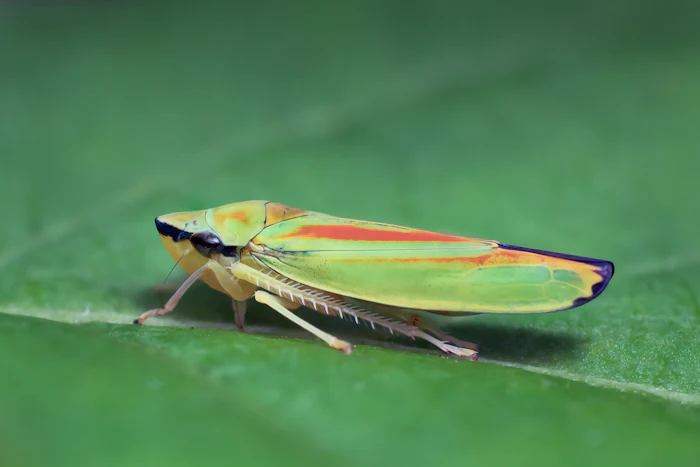
In an inspiring fusion of biology and engineering, researchers at Pennsylvania State University have drawn inspiration from the humble leafhopper to develop synthetic brochosomes — nanostructures with extraordinary optical and functional properties.
These tiny particles, naturally produced by leafhoppers to render themselves nearly invisible to predators, are now being mass-produced at an unprecedented scale, opening doors to revolutionary applications in camouflage, optics and medicine. The work was recently published in ACS Nano.
The Science Behind Brochosomes
Tak-Sing Wong, professor of mechanical and biomedical engineering at Penn State, explained in a Phys.org report that each brochosome is "smaller than a speck of pollen yet has astonishingly intricate architecture, looking like a perfectly patterned soccer ball covered with nanoscale pores."
These natural nanostructures reportedly absorb ultraviolet light and scatter visible light, creating an anti-reflective shield that makes leafhoppers nearly undetectable to predators.
Inspired by this natural marvel, Wong’s team developed a high-speed microfluidic platform capable of producing over 100,000 synthetic brochosomes per second. By mimicking the self-assembly processes found in leafhoppers, the researchers achieved nanoscale precision and scalability.
"Nature is the master of nanomanufacturing," Wong noted, per Phys.org, emphasizing how the team adapted biological principles to engineer these particles.
High-Speed Production of Synthetic Nanostructures
Also according to the Phys.org report, the synthetic brochosomes exhibit broadband and omnidirectional antireflection, making them ideal for applications like glare-free camera lenses, efficient solar panels and even military-grade invisibility cloaks. Beyond optics, their hollow, porous structure holds promise for energy storage, catalysis and drug delivery.
The ACS Nano article delves deeper into the science behind this breakthrough, explaining the team used amphiphilic block copolymers to replicate the natural self-assembly process of brochosomes. By carefully tuning the hydrophobic and hydrophilic properties of these polymers, the researchers controlled the size, pore geometry and wall thickness of the particles, achieving five distinct architectures that mimic those found in nature.
The study highlights how interfacial tension and molecular design govern the formation of these complex nanostructures, providing a scalable and efficient method for their production.
"Our group has been working on synthetic brochosomes for almost a decade," Wong said, in the Phys.org report. "This advance marks a significant step forward, not only recreating their complex architecture but also manufacturing them with unprecedented precision and scale."
As the team continues to refine their platform, the potential applications could range from pigments and protective coatings, to medical technologies.