Hair shine is one of those topics that feels familiar. As an industry, we’ve spent decades treating it as a surface effect: add oils, add silicones, smooth the cuticle, and shine appears. It’s a simple, intuitive model, and it has served product development well for a long time.
But as our diagnostic tools improve and ingredient choices evolve, it’s becoming clear that shine is more layered than we once thought. When you look closely at the physics of reflection, the chemistry of the cuticle, and the biology of the scalp, a more nuanced picture emerges—one where shine is less about adding something new and more about supporting the fiber’s natural ability to reflect light.
One area that deserves more attention is the behavior of the hair array. Consumers don’t see shine fiber by fiber; they see the collective optical behavior of thousands of fibers acting together. Even if a single fiber is in excellent condition, overall shine can drop when the array becomes disordered. When fibers lie parallel and follow a coherent direction, they create a smooth macro-surface that reflects light specularly. When the array is disrupted—through frizz, humidity, static, mechanical wear, curl-pattern irregularity, or uneven conditioning—fiber angles shift, diffuse scattering increases, and visible gloss declines.
This suggests that shine is shaped by two interconnected systems: the micro-scale structure (cuticle smoothness, lipid continuity, porosity, microfractures) and the macro-scale alignment (how the fiber bundle behaves as a whole). Everyday factors influence both. Humidity causes swelling and frictional drag. Grooming introduces micro-irregularities. Curl geometry affects alignment potential. Even sebum distribution plays a role; when evenly spread, it supports alignment, and when patchy or oxidized, it disrupts it.
The aim of this paper is not to prescribe a new model, but to offer a more holistic perspective—one that builds on established knowledge while highlighting emerging insights that may shape the next generation of shine technologies.
Shine is Fundamentally an Optical Phenomenon
At its core, shine is simply the visible outcome of how light interacts with the hair fiber. The balance between specular reflection (light reflecting in a single direction) and diffuse scattering (light bouncing in many directions) determines whether hair appears glossy or dull. Healthy hair reflects light coherently because its surface is smooth, continuous, and structurally intact. Robbins [1] and Swift [2] show that intact cuticles, low porosity, aligned cuticle edges, and minimal microfractures all contribute to this effect.
When the surface becomes irregular—through lifted cuticles, microcracks, lipid depletion, or increased porosity—light scatters, reducing shine even when conditioning agents are present. This helps explain why two fibers treated with the same conditioner can deliver different shine outcomes: the underlying topology matters.
The Geometry of Reflection
The optical behavior of hair is more complex than a simple mirror. Each fiber behaves as a cylindrical, semi-transparent, multilayered optical object. Light interacts with the cuticle surface, the cuticle–cortex interface, internal melanin granules, subsurface scattering pathways, and the fiber’s curvature and orientation.
Shine is therefore not a single event but a combination of multiple optical interactions. The “primary” reflection—the bright streak along the fiber—is highly sensitive to surface smoothness. The “secondary” reflection—the broader halo—depends on internal scattering and fiber alignment.
When fibers are aligned, these reflections overlap and reinforce one another, producing a strong, coherent shine band. When fibers diverge, the reflections disperse, weakening perceived gloss.
The Role of Refractive Index
Refractive index (RI) is another important factor. The closer the RI of a surface film is to the fiber’s natural RI (~1.55), the more coherent the reflection. Laba3 notes that silicones historically performed well because their RI values approached that of hair.
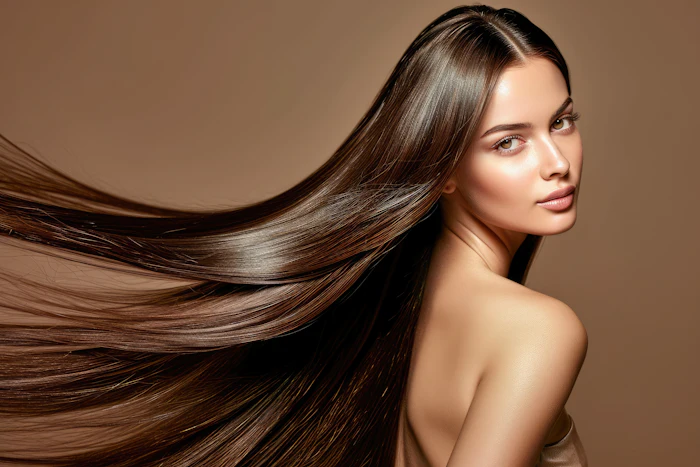
 At its core, shine is the visible outcome of how light interacts with the hair fiber. Parilov at Adobe Stock
But RI alone doesn’t guarantee shine. The film must also be thin, uniform, smooth, well-deposited, and mechanically stable. Many natural oils have high RI values but form less uniform films, which can lead to inconsistent shine. High-viscosity oils may resist spreading; low-polarity oils may bead; high-polarity oils may penetrate rather than coat.
Film Thickness: The Overlooked Variable
A film that is too thick can actually reduce shine by increasing surface roughness, creating micro-undulations, amplifying diffuse scattering, and altering fiber-to-fiber friction. This is why heavy oils can make hair look greasy rather than glossy.
The optimal film thickness for shine is typically in the tens of nanometers—not microns. Achieving this consistently across fibers of varying porosity is a major formulation challenge, and one reason smart deposition polymers are gaining attention.
Regulatory Pressure is Reshaping Shine Formulations
For many years, volatile silicones and fluorinated gloss agents were central to shine enhancement. Their combination of high RI, low surface tension, and uniform film formation made them highly effective. As regulatory scrutiny increases—particularly around D4/D5/D6 silicones and PFAS-derived materials4—formulators are exploring alternative approaches.
This shift doesn’t diminish the value of past technologies; it simply broadens the conversation. New materials must now be non-volatile, biodegradable, non-fluorinated, globally acceptable, sustainably sourced, and compatible with modern claims frameworks. It’s a demanding design space, but it’s also stimulating innovation.
Suppliers are responding with technologies such as Crodabond CSA, AquaStyle 300 N, Abil Soft AF 100, Genadvance Life and SilSense Bio 5. These materials aim to support cuticle cohesion, smooth micro-topography, and create thin, uniform films that enhance specular reflection. Rather than replicating volatile silicones, they offer alternative pathways to optical coherence.
The Rise of “Structural Shine” Claims
As volatile gloss agents decline, brands are reframing shine as a structural outcome rather than a superficial coating. Long-lasting gloss depends on the physical condition of the fiber—cuticle integrity, porosity, alignment behavior, and lipid continuity—rather than on temporary optical effects.
Claims are therefore shifting toward cuticle repair, porosity reduction, fiber alignment, microdamage smoothing, lipid replenishment, and optical surface engineering. Shine becomes something earned through improved fiber architecture, not simply applied.
Within this reframing, microdamage has emerged as a central contributor to dullness. High-resolution imaging techniques such as AFM, SEM, OCT, and confocal microscopy consistently show that microfractures, cuticle lift, and surface irregularities increase diffuse scattering and weaken specular reflection5,6. Wortmann7 demonstrated that even submicron defects disrupt optical coherence, while Robbins8 showed that chemical treatments generate microcracks long before visible damage appears.
Microdamage is also cumulative—thermal styling, UV exposure, mechanical grooming, chemical treatments, pollutants, and hard-water minerals all contribute. Each event may be small, but together they create a progressively rougher surface that scatters light more diffusely. Shine declines gradually because the fiber slowly accumulates nanoscale disruptions.
Shine Begins at the Scalp: The Role of Sebum Chemistry and Cleansing
Scalp biology plays a far greater role in shine than we often assume. Fresh sebum is not dulling; it can actually support fiber alignment, reduce friction, and enhance reflection. Problems arise when sebum oxidizes. Kaliyadan et al.9 show that UV, There is increasing evidence that microdamage plays a significant role in reducing shine. Oleg Gekman at Adobe Stock
Sebum distribution also matters. When evenly spread, it acts as a natural lubricant, hydrophobic barrier, and alignment aid. When patchy—through oxidation, over-cleansing, or disrupted lipid balance—it creates uneven optical zones that scatter light and reduce gloss.
Cleansing practices strongly influence this balance. Harsh surfactants can strip protective lipids, disrupt the scalp microbiome, increase TEWL, alter sebum composition, and accelerate oxidation. Microbiome-aware surfactants such as Mirasoft SL L60, TEGO Betain 810 and Plantapon LGC Sorb help preserve lipid quality and maintain a smoother, more uniform optical surface.
This oxidative pathway connects directly to another contributor to dullness: mineral deposition. Srinivasan10 showed that repeated washing with hard water leads to calcium and magnesium accumulation, forming a rigid, particulate layer that disrupts cuticle edges, increases roughness, and elevates fibre-to-fibre friction. SEM and elemental analysis confirmed cuticle lifting and micro-chipping, while tensile testing showed reduced flexibility and strength. In optical terms, both oxidised lipids and mineral deposits increase scattering by disrupting nanoscale smoothness.
Biodegradable chelators such as GLDA and Chelamax ECO can help prevent mineral-induced roughness and maintain optical clarity. Together, these insights highlight that shine is shaped not only by mid-lengths and ends but also by scalp health, lipid chemistry, and cleansing behavior.
Lipid Engineering: Restoring the Optical Barrier
External contributors to roughness sit alongside an intrinsic factor: the condition of the fiber’s own lipid envelope. The 18-MEA layer provides hydrophobicity, smooth cuticle overlap, and refractive-index continuity. When this layer is stripped—through bleaching, UV exposure, harsh surfactants, or cumulative wear—the fiber becomes more hydrophilic and more prone to micro-irregularities.
Robbins11 showed that loss of 18-MEA increases friction and scattering, directly reducing the fiber’s ability to reflect light coherently. Restoring this lipid architecture through biotech ceramides such as Ceramide III B and Hair Ceramide™ supports both biological repair and optical performance by rebuilding the smooth, continuous interface required for shine.
Oils, Esters and Polymers: Refractive Index Matters, but so does Deposition
Oils vary widely in their optical behavior. Castor, meadowfoam, and abyssinian oils have relatively high refractive indices (~1.47–1.48), which can support gloss by improving refractive-index continuity. However, as Laba14 notes, RI alone does not determine shine. The outcome depends on whether the material forms a thin, smooth, continuous film that preserves the fiber’s micro-topography. Deposition behavior, spreading, polarity, and compatibility with the cuticle all influence whether an oil enhances specular reflection or increases scattering.
The Challenge of Uniform Deposition
Many oils struggle to deposit uniformly. Depending on their polarity and molecular structure, they may penetrate instead of coat, bead on the surface, create uneven film thickness, migrate along the fibre, or oxidise and increase roughness. These behaviors introduce micro-irregularities that weaken optical coherence.
This is where smart deposition polymers become increasingly relevant. Polymers have long been used for conditioning and sensory modification, but their role in shine is being re-evaluated through the lens of surface optics. Smart polymers such as Abil EM 90, SilSense DW18 and Conditioneze NT20 can form the right film in the right place, responding to porosity, charge distribution, and hydrophobicity. They can adjust film thickness based on porosity and surface charge, helping create more uniform optical interfaces. Because shine is highly sensitive to nanoscale film thickness and uniformity, these polymers can create smoother, more coherent surfaces without adding weight. This represents a shift from heavy coating toward targeted, precision-based deposition.
The Future: Predictive Polymer Design
As predictive tools evolve—including machine-learning models that relate polymer structure to optical outcomes—smart polymers may play an increasingly important role in next-generation shine formulations. These models can simulate film thickness, RI matching, porosity-dependent deposition, surface-roughness reduction and optical coherence. This marks a shift from empirical formulation toward computationally guided optical engineering.
 Shine is a multifaceted property shaped by the interplay of microscale fiber integrity and macroscale fiber alignment.triocean at Adobe Stock
Optical Engineering: The Future of Shine
There is growing interest in shine technologies that focus on light-path engineering rather than traditional conditioning. Materials such as Reflect’Liss, Jaguar Optima and Luviset Clear AT 3 aim to smooth micro-topography, enhance RI continuity, and create optical surfaces that behave more like polished materials than biological fibers. Machine-learning models are beginning to predict shine based on porosity, cuticle angle, polymer RI, and film thickness.
Beyond Coatings: Structural Optics
Future shine technologies may involve nanoscale surface smoothing, refractive-index tuning, micro-alignment control, porosity-specific deposition, anti-scatter engineering, and fiber-array coherence optimization. This moves shine science closer to materials engineering, optics, and photonics—where the goal is not simply to coat the fiber, but to engineer the surface so that light reflects with maximum coherence.
Conclusion
Shine is a multifaceted property shaped by the interplay of microscale fiber integrity and macroscale fiber alignment. While traditional gloss agents have delivered strong performance for many years, evolving regulatory and sustainability expectations are encouraging a broader look at the structural and biochemical factors that influence shine.
Emerging evidence suggests that microdamage, lipid depletion, mineral deposition, and sebum oxidation all contribute to diffuse scattering. At the same time, the behaviur of the hair array—its alignment, tension, and coherence—plays a significant role in how shine is perceived.
The next generation of shine technologies may therefore benefit from a more holistic approach, incorporating microdamage repair, lipid engineering, microbiome-aware cleansing, chelation strategies, high-RI sustainable oils, smart deposition polymers, and optical engineering.
Shine is not simply something we apply; it is something we can help reveal by supporting the fiber’s natural ability to reflect light coherently. There is still much to explore, and the opportunity lies in how we choose to bring these insights together.
References
- Robbins, C. R. Chemical and Physical Behaviour of Human Hair, 5th ed.; Springer: New York, 2012.
- Swift, J. A. “The Cuticle: Structure and Function.” Journal of the Society of Cosmetic Chemists 1996, 47, 123-139.
- Laba, D. Rheological and Optical Properties of Oils in Cosmetics; CRC Press: Boca Raton, 2011.
- European Chemicals Agency (ECHA). “Restriction of D4, D5 and D6 under REACH.” European Chemicals Agency, Helsinki, 2023.
- Wortmann, F. J. “Optical Properties of Human Hair.” Journal of the Society of Cosmetic Chemists 2002, 53, 25-34.
- Yamauchi, R.; Ito, M.; Tanaka, Y.; et al. “Assessment of Hair Damage Using Optical Coherence Tomography.” Skin Research & Technology, 2018, 24(4), 667-673.
- Wortmann, F. J.; Sendelbach, G.; Popescu, C. “Correlation Between Surface Roughness and Shine.” Journal of Cosmetic Science, 2006, 57, 1-12.
- Robbins, C. R. “Chemical Damage and MicroCracking in Hair Fibres.” Journal of the Society of Cosmetic Chemists 1988, 39, 263-275.
- Kaliyadan, F.; et al. “Hair Shine: Physiology, Assessment and Management.” International Journal of Trichology, 2016, 8(3), 102–109.
- Srinivasan, G., et al. "Impact of hard water on hair," Int. J. Trichology, 2013, 5(3), 158-159.
- Robbins, C. R.; Crawford, R. J. “Cuticle Damage and the Loss of 18MEA from Hair.” Journal of Cosmetic Science, 1991, 42, 1-14.
- Laba, D. “Optical Properties of Cosmetic Oils.” In Handbook of Cosmetic Science and Technology, 4th ed.; Barel, A. O.; Paye, M.; Maibach, H. I., Eds.; CRC Press/Elsevier: Boca Raton, FL, 2014; pp. 439-452.