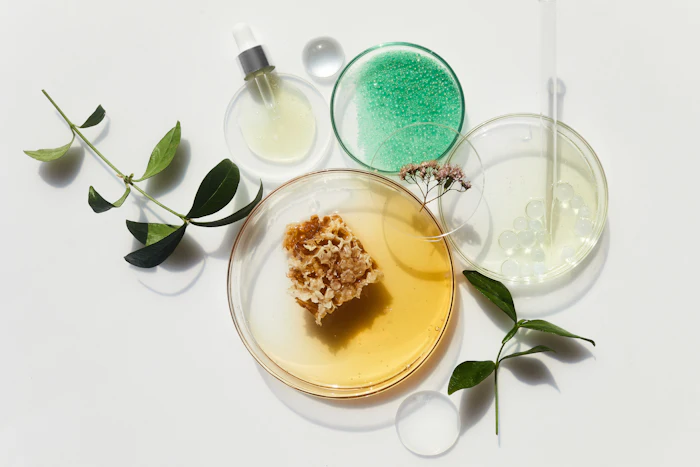
The latest wave of cosmetic ingredients is moving beyond simple clean beauty marketing into a realm of high-precision biotechnology and hyper-targeted solutions. Rather than vague botanical claims, ingredients are engineered to address specific, often overlapping physiological gaps. For instance, new actives are tackling the dual frustration of adult acne and aging simultaneously, while others are using "bio-intelligent" matrices to treat multi-ethnic hair textures with unprecedented specificity.
This surge of innovation comes as the bio-based cosmetics and personal care ingredients market is set to nearly double — projected to grow from US $5.29 billion in 2025 to$9.10 billion by 2035 at a CAGR of 5.5%, according to InsightAce Analytic.
Perhaps the most significant shift is the move from extraction to creation. We are entering an era where lipids are created from carbon emissions rather than crops, and yeast fermentation replaces palm oil, effectively decoupling beauty ingredients from volatile agricultural supply chains. These innovations represent a sophisticated evolution in the market, where sustainability is built into the molecular design rather than added as an afterthought.
The following compilation details the latest ingredient launches reshaping the landscape of skin care, hair care and formulation science.
Advanced Skin Care and Anti-Aging
PureBlome: A Dual Solution for Acne and Aging
Provital addresses a common dilemma for women aged 30 to 50: the overlap of adult acne and signs of aging. PureBlome (INCI: Water (Aqua) (and) Propanediol (and) Glycerin (and) Bacillus Ferment (and) Pentylene Glycol (and) Levulinic Acid (and) Glyceryl Caprylate) is a postbiotic ferment derived from the endophytic bacteria Bacillus velezensis, isolated from hyssop. It is engineered to simultaneously treat adult acne and signs of aging—two conditions that frequently overlap.
PureBlome’s effects are supported by clinical data showing a 14% increase in collagen I, a 25% increase in elastin, a 37% reduction in advanced glycation end-products (AGEs), and a 77% acceleration of fibroblast migration. In vivo results include a significant reduction in wrinkle depth and improved elasticity within 14 days.
For sebum and pore regulation, the ingredient achieves a 16.5% reduction in sebum by day 56 and a 27% reduction in total lipids, translating to a 10.1% decrease in pore size and a visible reduction in acne lesions. PureBlome also modulates inflammatory pathways by reducing IL-6 (down 33.5%) and IL-8 (down 41.4%), helping to fade acne marks and post-inflammatory hyperpigmentation while improving skin tone evenness.
DermCeutical EDL: Needle-Free Skin Tightening
Debut’s DermCeutical EDL (INCI: Not Provided) is a topical ingredient designed for professional-grade skin tightening without the use of heat, needles or invasive procedures. Developed through an integrated platform combining AI, skin genomics and biotechnology, it works by activating the same cellular pathways as in-office tightening treatments — targeting skin-support biomarkers involved in elasticity and dermal structure.
Rather than relying on controlled injury, DermCeutical EDL biologically modulates skin cells to promote elastin production, downregulate inflammatory signals, and reverse adverse gene expression, supporting skin longevity, per the company. In a 12-week clinical study, it achieved a 100% fine-line improvement rate and a 73% improvement in skin sagging versus placebo. The ingredient also rejuvenated aged cells by 31%, visibly improving skin resilience and structure—all without irritation or downtime. DermCeutical EDL is positioned as a procedure-inspired innovation for daily face and neck treatments, allowing consumers to access tightening benefits with topical use.
SenoCellTec: Clearing Zombie Cells
Mibelle’s SenoCellTec (INCI: Malus Domestica Fruit Cell Culture Extract (and) Vitis Vinifera (Grape) Fruit Cell Extract (and) Rhododendron Ferrugineum Extract (and) Glycerin (and) Pentylene Glycol (and) Water (Aqua) introduces a "clear–fill–revive" mechanism to skin rejuvenation. This next-generation senolytic works by removing senescent "zombie" cells, activating the skin’s stem cells, and rebuilding skin structure for firmer, smoother and more resilient skin.
According to the company, SenoCellTec is designed to enhance the skin barrier function, firmness and elasticity, delivering a lifted and revitalized appearance. By supporting deep skin renewal at the cellular level, this ingredient promotes long-lasting beauty and visible rejuvenation from within.
Rare Botanicals via Sustainable Biotech
Uniproma is making rare botanicals accessible for skin care through plant cell mass cultivation technology. Using patented single-use biodegradable reactors, Uniproma can reportedly dramatically reduce the cost of cell culture, enabling sustainable and innovative ingredient sourcing. This method preserves the unique properties of rare plants while aligning with eco-conscious practices, per the company.
Among the featured ingredients are:
- BotaniCellar Tianshan Snow Lotus (INCI: Saussurea Involucrata Callus Extract (and) Pentylene Glycol (and) Butylene Glycol), which reduces melanin and enhances skin radiance;
- BotaniCellar Desert Rose (INCI: Adenium Obesum Leaf Cell Extract (and) Pentylene Glycol (and) Butylene Glycol), which provides intense hydration and anti-inflammatory benefits;
- BotaniCellar Crithmum Maritimum (INCI: Crithmum Maritimum Callus Extract (and) Pentylene Glycol (and) Butylene Glycol), praised for its barrier-strengthening and soothing effects;
- BotaniCellar Edelweiss (INCI: Leontopodium Alpinum Callus Extract (and) Pentylene Glycol (and) Butylene Glycol), known for antibacterial and microbiome-balancing properties; and
- BotaniCellar Eryngium Maritimum (INCI: Eryngium Maritimum Callus Culture Extract (and) Pentylene Glycol (and) Butylene Glycol), recognized for supporting skin repair and stress resistance.
Uniproma’s approach ensures a sustainable supply of high-quality botanical actives, bringing luxury skin care benefits within reach while prioritizing efficacy and environmental responsibility.
 Rifqi at Adobe Stock
Next-Generation Hair Care
CoverTrix: Bio-Intelligent Shield
Provital’s CoverTrix (INCI: Water (Aqua) (and) Glycerin (and) Amaranthus Caudatus Seed Extract (and) Pentylene Glycol (and) Zea Mays Starch (and) PCA Glyceryl Oleate (and) Levulinic Acid (and) Sclerotium Gum (and) Glyceryl Caprylate (and) Lysine) uses a 3D matrix technology to provide a sustained-release system of amaranth seed extract. This bio-intelligent shield is designed to improve both the internal structure and external mechanics of all hair types, with specific testing on Afro, curly and straight textures.
According to the company, the ingredient strengthens hair fibers, enhances breakage resistance and improves durability against daily mechanical stress. CoverTrix also creates a bioadhesive film that reduces fiber friction and increases shine, resulting in a smoother cuticle surface, a 24-hour shine effect, and improved combability. For Afro and wavy hair, it improves internal water retention and optimizes surface water management to reduce air- and blow-drying time, thereby lowering cumulative heat exposure.
Key benefits include:
- Strengthening: Increases tensile strength across textures — straight (+21%), wavy (+16%), curly (+18%) and Afro (+13%).
- Gloss: Reduces fiber friction by 13% and increases shine by up to 22%.
- Drying efficiency: Reduces air-drying time by 42% and blow-drying time by 28%, minimizing heat exposure.
ProCondition 22: Sustainable Quat Replacement
Inolex’s ProCondition 22 (INCI: Brassicamidopropyl Dimethylamine) is designed to replace traditional quats such as BTAC and CTAC in hair and skin care formulations. It is biodegradable, non-irritating, and works by forming lamellar gel networks that condition hair, emulsify formulations and moisturize skin. These lamellar liquid crystals reportedly mimic the natural structure of skin and hair, creating a soft, non-greasy feel.
ProCondition 22 is formulated to smooth lifted cuticles, seal the hair shaft, and reduce friction between strands, improving the appearance and feel of hair and reducing frizz. Tests on various hair types — including Chinese, European brown and multi-ethnic curly (3A) hair — have demonstrated that ProCondition 22 provides wet combability comparable to BTAC in natural conditioning formulas. In skin care, it is designed to offer immediate and lasting hydration, with clinical studies indicating it replenishes moisture within 15 min and maintains hydration for up to 24 hr.
This ingredient is suitable for use in shampoos, rinse-off conditioners and leave-on treatments, as well as emulsions, cleansers and body washes. ProCondition 22 features 83% USDA Certified Biobased Content and is made without palm, is readily biodegradable, and meets clean beauty standards; it is also halal certified, kosher compliant, vegan, cruelty-free and listed on China’s IECIC.
Sustainable Lipids and Biotech Oils
Carbon-to-Cream: Savor
Savor, the carbon-based fat startup known for its food-tech innovations, is branching into beauty with its Personal Care and Beauty division. The company Boadicea at Adobe Stock
Using proprietary thermochemical processes and feedstocks such as captured CO₂, green hydrogen and methane, Savor engineers fatty acid profiles for consistency and specific performance needs. Its platform includes alternatives to caprylic/capric triglyceride, vegan tallow for skin-conditioning without livestock, skin-mimetic lipids and a petrolatum alternative.
After launching commercial food production in 2025 and gaining early traction with beauty contract manufacturers, Savor now targets beauty brands seeking palm-free, high-functionality drop-ins that deliver reliable performance and radical sustainability. The company is already advancing INCI submissions and scaling its output to meet cosmetics industry needs, positioning its carbon-to-cream lipids as a next-generation solution for formulators.
Yeast-Based Oil: ÄIO
ÄIO recently announced the successful production of its first tonne of sustainable, yeast-derived oil, marking a milestone in the commercialization of alternatives to unsustainable fats and oils. The company’s process transforms agricultural and wood industry side streams into high-quality oils and fats, designed to replace palm oil, coconut oil and petroleum-based mineral oils in cosmetics and personal care.
This innovation is aimed at addressing challenges such as deforestation, microplastics and PFAS regulations that impact the industry. With the technology proven at tonne scale, ÄIO is advancing plans for a commercial plant with an annual capacity of 2,000 tonnes and has already distributed samples to manufacturers for further testing — providing a reliable and ethical alternative for formulators seeking to meet both performance and sustainability goals.
Whey Permeate Upcycling: Milcobel x NoPalm
This partnership upcycles whey permeate, a byproduct of cheese production, into sustainable oils using fermentation technology developed by NoPalm Ingredients. The process transforms agro-industrial sidestreams like whey permeate into oils and fats that are identical to conventional palm and tropical oils. This innovative approach eliminates the need for palm-derived raw materials, providing a sustainable, low-emission alternative that addresses environmental concerns related to deforestation and resource use.
Industrial trials have confirmed the viability of using whey permeate as a feedstock, consistently producing high-quality oils at scale, according to the companies. With the feasibility of commercial production established, the partnership aims to launch a demonstration facility and explore co-location at existing dairy production sites, maximizing efficiency and promoting true circularity in the supply chain.
Sun Care and Color Defense
BioSheer Zinc Dispersion
Azafran Innovación’s BioSheer Zinc Dispersion (INCI: Zinc Oxide (and) Caprylic/Capric Triglyceride (and) Polyhydroxystearic Acid) is a blend featuring uncoated zinc oxide formulated for high transparency and robust broad-spectrum UVA/UVB protection. This dispersion is engineered to eliminate the whitening effect commonly associated with mineral sunscreens and to provide balanced coverage suitable for everyday use and all skin tones.
It is designed for easy integration into various formulations and meets strict global UVA protection standards. Additionally, BioSheer Zinc Dispersion is reef and marine safe, biodegradable, and its safety has been confirmed by clinical studies showing that zinc oxide nanoparticles do not cause cellular toxicity, even with repeated application. As a naturally occurring mineral, ZnO in this ingredient offers consistent protection while aligning with demands for eco-consciousness and safety in sun care.
Silicone Dispersants for Stability
Shin-Etsu Silicones of America recently introduced novel silicone dispersants to address challenges in color cosmetics and mineral sunscreens. Showcased at the SCC 79th Annual Scientific Meeting, these dispersants enable higher pigment and mineral UV filter loadings while maintaining stability, sensory appeal and low viscosity.
KF-6115 (INCI: Lauryl Polyglyceryl-3 Polydimethylsiloxyethyl Dimethicone), a polyglycerin-modified silicone dispersant, is designed to promote consistent powder dispersion in oils, support maximum UV absorber loading with minimal viscosity, and deliver a silky, lightweight feel.
KP-578 (INCI: Acrylates/Ethylhexyl Acrylate/Dimethicone Methacrylate Copolymer), a silicone/acrylate polymer for color cosmetics, prevents streaking and separation by facilitating uniform pigment dispersion — even at high up to 20%) pigment loads — allowing for stable, streak-free coverage. These innovations ensure clear finishes across skin tones and offer ease of formulation for sunscreens and foundations with demanding performance requirements.
Solving UV Filter Crystallization
Ashland’s X-Tend 226 Ester (INCI: Phenethyl Benzoate) is a specialized polar ester created to address the common challenge of solubilizing solid organic UV filters, such as bemotrizinol, triazines or triazone derivatives. X-Tend 226 enhances the performance and stability of sun care products by preventing UV filter crystallization, ensuring consistent protection throughout a product's shelf life.
It also supports formulation efficiency, helping to reduce the required oil phase and the need for additional emulsifiers, while positively impacting the final product's sensory feel. In addition to its benefits for sun care, X-Tend 226 demonstrates utility in hair serums and sprays by imparting emolliency and shine, further streamlining the development of modern cosmetic formulations.
Texture, Delivery and Preservation
MIT[HD]: Deep Delivery System
Labio has launched its patented MIT[HD] technology, a delivery system that uses a multi-lamellar vesicle (MLV) structure to deliver high concentrations of active ingredients deeply into the skin — stably and with strong performance. The system combines mannosyl erythritol lipid (MEL) derived from natural fermentation with phospholipids to mimic the skin's own structure, enhancing biocompatibility. This allows MIT[HD] to stably carry both oil-soluble and water-soluble actives, ensuring they reach their target for maximum impact through a multi-infusion mechanism.
The MEL tri-acyl components act as cross-linkers between vesicle layers, creating a robust, resilient structure that helps protect and prolong the potency of actives from production through application. MIT[HD] is produced using a low-energy cold process, emphasizing sustainability alongside efficacy. Labio’s approach ensures high stability and maximizes the absorption and effectiveness of skin care formulations using this system.
 The Little Hut at Adobe Stock
ViscoPure: Natural Thickening Power
Solabia Group’s ViscoPure (NCI: Not Provided) is a natural aqueous thickener developed by PolymerExpert in France, formulated from modified glucomanane and xanthan gum combined in a 3D network. Designed for high-efficiency thickening, ViscoPure delivers up to 20× the thickening power of standard xanthan gum at just 0.1%, allowing for low-use, stable formulations, per the company.
The ingredient provides broad pH tolerance, resilience to electrolytes, emulsion stabilization and effective suspension of pigments and particles, making it suitable for serums, gels, emulsions, and gel patches. ViscoPure works in both cold and hot processing, giving formulators flexibility from concept to scale-up. It also enhances texture and sensory properties, yielding smooth, transparent, non-stringy gels in line with minimalist aesthetic trends. As a 100% natural-origin ingredient (ISO 16128) produced through environmentally responsible processes, ViscoPure offers a natural and effective alternative to synthetic thickeners without compromising on performance.
AmpliPQ-CF: Clean Preservation
Curie Co.’s AmpliPQ-CF (proposed INCI: Sodium Benzoate (and) Polyamine) is a modern, chelator-free preservation system built specifically for clean and sustainable cosmetics and personal care formulas. It boosts the efficacy of sodium benzoate by combining it with a polyamine, delivering robust, broad-spectrum protection while meeting clean label standards, especially at or below pH 6, the company reports.
AmpliPQ-CF serves as an effective alternative to phenoxyethanol, empowering formulators to develop products that are free from isothiazolinones, parabens, and formaldehyde-releasing ingredients. It is water-soluble, colorless and odorless in formulations, making it compatible with fragrances and dyes, and is versatile across a wide range of rinse-off and leave-on applications, including shampoos, conditioners, cleansers, and creams. AmpliPQ-CF is readily biodegradable, US and EU compliant, and is designed to meet the most stringent clean beauty and retailer standards, including Clean Beauty at Walmart, Target Clean, Conscious Beauty at Ulta, and Sephora.
AdvensProtect: Green Multifunctionals
Finally, Seqens expands its green offerings with AdvensProtect 56E Green (INCI: Pentylene Glycol (and) 1,2-Hexanediol (and) Ethylhexylglycerin) and 58E Green (INCI: Pentylene Glycol (and) Caprylyl Glycol (and) Ethylhexylglycerin). These new multifunctional blends provide humectant and emollient properties while ensuring excellent product protection, serving as alternatives or boosters to traditional preservative systems in cosmetic formulations.
AdvensProtect 56E Green is a 100% bio-based blend recommended for sensitive skin products, while AdvensProtect 58E Green offers similar benefits using sustainable ingredients. Both are ISO 16128 certified, COSMOS approved and suitable for diverse applications ranging from creams and lotions to shampoos and sunscreens. The ingredients are easy to formulate with, offering temperature and pH independence, and are designed to help reduce the concentration of active preservatives needed, aligning with green chemistry principles.