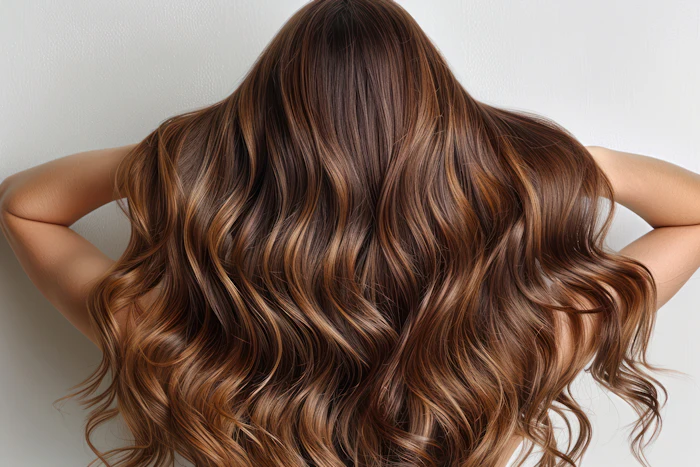
Shiny hair has always meant “healthy,” but in 2026 it means something more loaded. It signals discipline. Continuity. A certain fluency in maintenance culture. In the same way glowing skin has become shorthand for barrier health and biohacking literacy, glossy hair has quietly entered the longevity chat.
Scroll through social media and you’ll see it everywhere: glass hair, liquid hair, mirror shine. These aren’t just aesthetic descriptors; they’re behavioral ones. They describe hair that moves predictably, reflects light coherently, and appears—crucially—unbothered by time.
And what’s striking is how age-agnostic this desire has become. A 25-year-old wants shiny hair. A 55-year-old wants shiny hair. The visual endpoint is almost identical. But biologically, chemically, and strategically, the path to that shine diverges sharply with age.
Hair aging isn’t just about accumulated damage; it’s also biological. Hormonal changes affect sebum production, fiber diameter, and growth cycles. Hair may grow more slowly, emerge finer, or become more brittle.
These shifts alter how hair interacts with formulations. Products designed for youthful hair may no longer deposit optimally or provide sufficient lubrication. Longevity-focused formulation requires adjustments in molecular weight, charge density, and deposition behavior to meet hair where it is—not where it used to be. Same gloss. Different timelines.
Shine, in this context, becomes a measure of adaptation. How well does the system evolve with the consumer?
From a physics standpoint, hair shine is straightforward. Smooth, aligned cuticles create specular reflection, meaning light reflects in a single direction. Rough, lifted, or eroded cuticles scatter light, producing dullness.
From a cultural standpoint, shine is anything but simple. Humans read gloss as health, youth, cleanliness, and control. Dull hair—fairly or not—gets coded as neglect, stress, or decline. In a cultural moment obsessed with aging “well” rather than aging less, shine has become a proxy for successful long-term care.
Shiny hair doesn’t just look good today. It implies that someone has been thinking ahead.
The Cuticle is the Message
Hair fibers are wrapped in overlapping cuticle cells coated with a lipid-rich epicuticle. This outer layer governs friction, hydrophobicity, and light reflection. When intact, it produces shine. When compromised, it tells a different story.
Cuticle damage accumulates through:
- UV-induced lipid oxidation
- Mechanical abrasion from brushing and styling
- Repeated swelling and contraction during washing
- Chemical processing and thermal stress
Aging compounds these effects. Over time, hair shows reduced surface lipids, increased porosity, lower tensile strength, and decreased elasticity—a pattern well documented in fiber aging studies1-3. As 18-MEA is lost from the cuticle surface, friction increases and hydrophobicity declines, disrupting the uniform light reflection required for high gloss.
Clinical testing on hair treated with Oriflame’s Duologi Intense Repair Shampoo shows how cuticle repair translates into gloss. The formula uses oat-derived lipids that naturally self-organize into lamellar structures, mimicking the lipid arrangement of healthy hair.
The DSC hair damage/protein protection study evaluated how the products affected internal hair damage by measuring the denaturation temperature of hair proteins using Differential Scanning Calorimetry (DSC). Higher denaturation temperatures indicate less damaged hair protein structures. Further, the anti–hair breakage study evaluated how well the products reduced hair fiber breakage after repeated mechanical stress (combing). Several Oriflame's hair care products were tested and compared.
Instrumental analysis, including DSC (differential scanning calorimetry) and breakage testing, showed smoothing of micro-cracks along the cuticle surface—reducing structural discontinuities that scatter light. When lipid order is restored, the cuticle behaves less like a cracked mirror and more like a continuous surface, allowing shine to emerge as a structural outcome rather than a cosmetic overlay.
This is why shine functions as a kind of diagnostic. It reflects not just surface condition, but the history of the hair.
 Bijac at Adobe Stock
Gentle Cleansing: The Unsung Anti-Aging Hero
Cleansing is rarely framed as anti-aging, but it should be. Not because washing is harmful, but because it’s frequent—and frequency turns small insults into structural change.
Every wash causes hair to swell as water penetrates the cortex, lifting the cuticle. As the hair dries, it contracts. Over decades, this repeated motion weakens cuticle adhesion and increases surface roughness. Repeated swelling and contraction during washing accelerates cuticle fatigue, particularly in older fibers with reduced cohesive strength4.
At 25, hair typically rebounds from this cycle with minimal visible consequences. Sebum production is higher, cuticles reseal more efficiently, and damage feels reversible. At 55, the same routine can accelerate dullness, dryness, and fiber fatigue.
Formulation Matters
Mild surfactant systems—such as blends of sodium cocoyl isethionate, sodium lauroyl sarcosinate or disodium laureth sulfosuccinate—reduce lipid stripping while maintaining cleansing efficacy. pH-balanced formulas (≈4.5–5.5) support cuticle cohesion, while conditioning agents incorporated into shampoos reduce friction at the earliest step.
Gentle cleansing isn’t about being precious. It’s about cumulative damage control over decades of washing.
Repair: Cosmetic Shine vs Structural Memory
“Repair” is one of the most overused words in haircare, often used to describe everything from temporary smoothing to genuine fiber reinforcement. The distinction matters— especially when longevity is the goal.
Some repair mechanisms are primarily cosmetic. Cationic polymers and film-formers—such as polyquaternium-10 or guar hydroxypropyltrimonium chloride—smooth the cuticle surface, increasing shine immediately. The effect is real, but transient.
Others aim for structural support. Hydrolyzed proteins (hydrolyzed keratin, hydrolyzed wheat protein) can fill micro-defects along the cuticle and cortex, improving strength and reducing breakage. Bond-building technologies target weakened internal structures, helping hair better tolerate mechanical and chemical stress.
This range was extensively tested but to mention only two, it was tested by Friction Force and Polarized Light Microscopy (X-Polar):
- Friction force: The testing was conducted by measuring friction force on hair tresses, since lower friction correlates with smoother, softer hair. The study aimed to determine if using Oriflame Intense Repair Overnight Serum and Shampoo as part of a routine for 10 applications (on extra damaged hair) enhances and improves softness and conditioning properties.
- Polarized Light Microscopy (X-Polar) uses polarized light to highlight and analyze the internal structures of hair, such as keratin fibres and hair bonds, providing detailed images and data on the hair's alignment, integrity, and condition after using Oriflame Intense Repair Overnight Serum and Shampoo as part of a routine for 10 applications on extra damaged hair.
Clinical testing on Oriflame’s Duologi Bond Repair range illustrates how structural repair becomes visible. Using X-polar analysis to assess the formation of new internal bonds, treated hair showed a 31% improvement in keratin integrity—evidence of reinforcement within the fiber, not just surface smoothing. That internal change translated externally: in consumer testing, 93% of users reported hair looking shinier after four weeks of use. The result underscores a critical distinction in modern repair—shine lasts longest when it’s supported by internal structure, not just coated on top.
For younger consumers, repair is often episodic—used after overstyling or coloring. For mature consumers, repair becomes systemic: maintaining fiber integrity so future damage progresses more slowly—and shine remains achievable.
In both cases, shine is the visible payoff. Longevity determines whether it persists.
Oils vs. Silicones: Function, Friction and Cost of Ideology
Silicones are currently experiencing what could best be described as a reputational collapse. As regulatory pressure increases on certain cyclic volatile silicones—most notably cyclotetrasiloxane (D4) and cyclopentasiloxane (D5)—due to concerns around environmental persistence and bioaccumulation, the nuance has largely disappeared from the public conversation.
What’s often missed is that these restrictions are environmental, not fiber-related. They do not imply that all silicones are harmful to hair, nor that silicones as a class are functionally obsolete.
From a hair biology perspective, silicones remain some of the most effective materials we have for reducing friction, improving cuticle alignment, and protecting aging fibers from mechanical wear. Non-volatile silicones such as dimethicone and amodimethicone form lubricating films that lower combing forces, reduce cuticle chipping, and support coherent light reflection over time1.
This distinction matters more with age. As hair loses surface lipids—particularly 18-methyleicosanoic acid (18-MEA), which normally confers hydrophobicity and low friction—the cuticle becomes more prone to abrasion, moisture loss, and diffuse light scattering2. Ingredients that replace lubrication are no longer cosmetic enhancements; they are mechanical stabilizers.
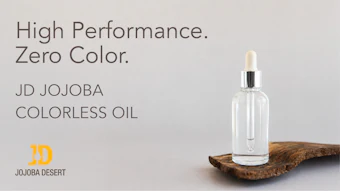
Natural oils offer complementary benefits. Lipid-replenishing oils such as Argania spinosa kernel oil or Simmondsia chinensis (jojoba) seed oil help restore hydrophobicity to aging cuticles, reducing moisture loss and improving flexibility.
For a 25-year-old, the absence of silicones may go unnoticed. Hair grows quickly. Damage is forgiven. Shine can be borrowed from styling alone.
For a 55-year-old, the margin for error is narrower. Friction compounds. Fiber Parilov at Adobe Stock
This is where longevity reframes the conversation. The question is no longer “Is this ingredient trendy?” but “Does this ingredient reduce damage over time?”
The future of shine is not about ingredient bans masquerading as moral victories. It’s about smarter formulation: choosing materials based on environmental responsibility and fiber biology, rather than collapsing complex chemistries into binary good-versus-bad narratives.
And in a longevity-focused era, boring, functional, damage-reducing ingredients may be exactly what shiny hair needs.
Shine as a Longevity Metric
In skincare, glow has become synonymous with barrier health and resilience. Hair is following the same trajectory. Shine is no longer just a styling finish—it’s a proxy for fiber integrity, lubrication, and cumulative care.
This is why “glass hair” resonates so strongly now. It implies not just smoothness, but continuity. Hair that reflects light consistently suggests a system—biological, chemical, behavioral—that’s working over time.
In longevity culture, shine quietly communicates success.
A 25-year-old and a 55-year-old can sit in the same salon chair and ask for “more shine.” Chemically speaking, they are not asking the same thing.
Younger consumers tend to prioritize immediate performance. Hair grows quickly, damage feels reversible, and products are judged on instant payoff. Mature consumers evaluate products differently. Hair growth is slower, damage accumulates, and the cost of error is higher. Shine is still desired—but not at the expense of future integrity.
This reframes haircare as risk management. Younger haircare emphasizes enhancement. Mature haircare emphasizes preservation. Both converge on the same optical endpoint.
Gloss Isn't a Moment. It’s a Timeline
The future of hair shine isn’t brighter gloss boosters or heavier oils. It’s smarter formulation—products designed with time in mind. Systems that respect the physics of friction, the biology of aging, and the psychology of longevity.
Whether you’re 25 or 55, the desire is the same: hair that looks alive. The difference lies in how much history that hair carries—and how much future it still needs to survive.
In that sense, shine is no longer just about reflection. It’s about foresight. As a parting gift, I would like to leave you with a thought: Would you rather leave the house with no make-up on or leave the house having bad/greasy hair?
References
- Robbins, Clarence R. Chemical and Physical Behavior of Human Hair. 5th ed. Berlin: Springer-Verlag, 2012.
- Swift, J.A. "Human Hair Cuticle: Biologically Conspired to the Owner's Advantage." Journal of Cosmetic Science 50, no. 1 (1999): 23–47.
- Wortmann, F.J. "Analyzing the Laser-Light Reflection from Human Hair Fibers I: Light Components Underlying the Goniophotometric Curves and Fiber Cuticle Angles." Journal of Cosmetic Science 54, no. 3 (2003): 301–316.
- Wortmann, F.J., A. Hullmann, and C. Popescu. "Water Management of Human Hair." International Journal of Cosmetic Science 30, no. 5 (2008): 388–389.
- Oriflame Cosmetics. "Duologi Intense Repair Shampoo: Clinical Evaluation Data." Internal study, [2022].
- Oriflame Cosmetics. "Duologi Bond Repair Range: Clinical Evaluation Data." Internal study, [2024/2025].