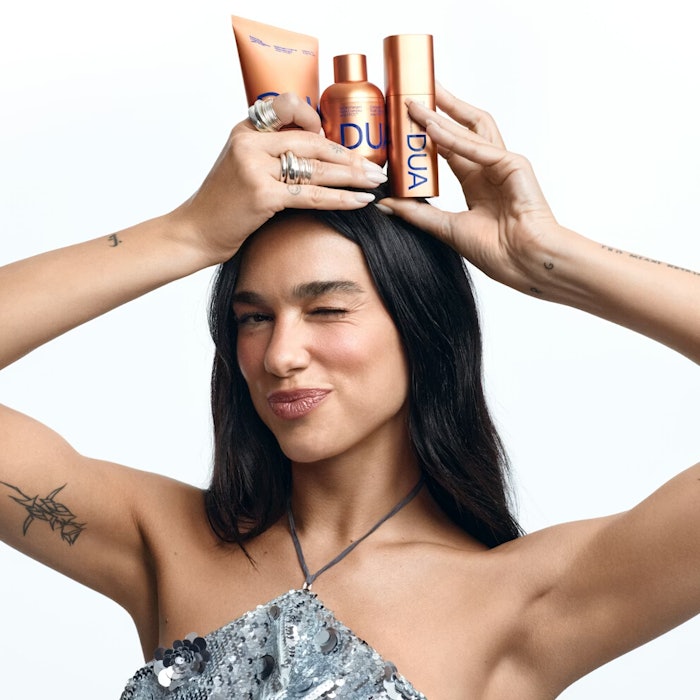
In November 2025, pop singer/songwriter and model Dua Lipa launched her eponymous skin care line Dua in collaboration with beauty brand Augustinus Bader. The Dua brand consists of three products: the Renewal Cream ($75/50 mL), the Supercharged Glow Complex ($80/30 mL) and the Balancing Cream Cleanser ($40/125 mL). Lipa aimed to create a minimal lineup of essential products that were clean, fragrance-free and effective, meant to be used daily.
Dua is the latest in a string of beauty brand launches in the last decade. The first celebrity-owned beauty brand was Iman Cosmetics, founded by supermodel Iman Abdulmajid in 1994. Iman innovated by offering diverse makeup colors to appeal to women of varying skin colors.
This article is only available to registered users.
Log In to View the Full Article
In November 2025, pop singer/songwriter and model Dua Lipa launched her eponymous skin care line Dua in collaboration with beauty brand Augustinus Bader. The Dua brand consists of three products: the Renewal Cream ($75/50 mL), the Supercharged Glow Complex ($80/30 mL) and the Balancing Cream Cleanser ($40/125 mL). Lipa aimed to create a minimal lineup of essential products that were clean, fragrance-free and effective, meant to be used daily.
Celebrity Brand Boom
Dua is the latest in a string of beauty brand launches in the last decade. The first celebrity-owned beauty brand was Iman Cosmetics, founded by supermodel Iman Abdulmajid in 1994. Iman innovated by offering diverse makeup colors to appeal to women of varying skin colors.
Many celebrity brands followed, among them, KORA Organics, Kylie Cosmetics and Fenty Beauty. It seems that nearly every headline-making pop star now owns a brand. Unlike Iman Cosmetics, celebrity brands often don’t have a strong unique value proposition. They appeal to the celebrity’s social media followers, which may number in the hundreds of millions.
Science-Backed Dua — A Brief History
 Dua distinguishes itself by emphasizing its scientific foundation. The brand is built around the Augustinus Bader (AB) TFC5 technology, a less costly version of AB's TFC8 complex.Image courtesy of Dua
In contrast, Dua distinguishes itself by emphasizing its scientific foundation. Dua is built around the Augustinus Bader (AB) TFC5 technology, a less costly version of AB's TFC8 complex. The latter is the basis of AB's The Cream, an ultra-premium product priced at $305/50 mL.
TFC stands for "Trigger Factor Complex," a wound-healing technology invented by Augustinus Bader, M.D. Bader is a professor of applied stem cell biology and cell technology at the University of Leipzig, Germany. His work uses stem cells to reduce skin aging and advance wound healing.
The brand began when co-founder Charles Rosier met with Bader on the recommendation of friends, who would visit Bader’s spa in Leipzig. According to the New York Times, early customers included stars Melanie Griffith and Gwyneth Paltrow, who were enthusiastic about the cream1 — although there is no peer-reviewed clinical test evidence that the AB cream is more effective than a basic moisturizer, per Allure and The Niche.2, 3
Erythropoietin-Powered Skin Care
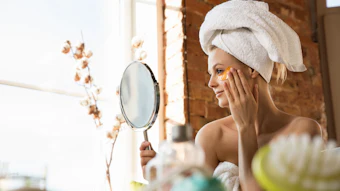
 In November 2025, pop singer/songwriter and model Dua Lipa launched her eponymous skin care line Dua in collaboration with beauty brand Augustinus Bader. Dua is built around the Augustinus Bader (AB) TFC5 technology.Image by ltyuan at Adobe Stock
Bader is the inventor on five recently published patents and patent applications claiming cosmetic formulations containing peptides with protein sequences derived from erythropoietin (EPO).4 This is a glycoprotein cytokine — a small signaling protein with oligosaccharide side chains.5
EPO is a well-known protein in wound healing. It is a hormone that stimulates red blood cell production in the bone marrow; in fact, EPO has been banned for decades as a performance-enhancing drug in sports such as cycling and tennis.
The peptide sequences claimed by Bader are fragments of the full EPO protein with a chain length of 7 to 40 amino acids. According to the patents, TFC contains EPO protein fragments that are linked to lipid chains by covalent or ionic bonds, or by forming a micelle or liposome, making them capable of penetrating the skin. Additionally, they are combined with a compound that acts on blood vessels and enhances the transport of the peptides to receptor cells.
This “triggering” compound is said to be an amino acid chain with 1-3 amino acids. Together, these 3 components — peptide, lipid and amino acid — make the TFC.
Trigger Factor Complexes: A Closer Look
The Dua Renewal Cream ingredient list (see below) provides more evidence for the composition of the TFC5 vs. TFC8 technologies. All three Dua products contain TFC5 and have a peptide set consisting of: oligopeptide-195 to 199 and oligopeptide-6, with arginine as the only amino acid and lecithin as the lipid component.
In contrast, the main AB product claiming TFC8 on its label — AB's The Cream (see ingredients below) — contains: oligopeptide-177; the amino acids arginine, phenylalanine, glycine, lysine, proline and alanyl glutamine; and the lipids cholesterol and ceramides.
Interestingly, however, AB's other TFC8-powered products, The Elixir and The Vitamin Serum, contain oligopeptide-195 to 199 and oligopeptide-6, similar to Dua's Cream, so these are not unique to the TFC5 technology. In general, but not universally, the distinguishing attributes to TFC8 appear to be the oligopeptide-177 in combination with amino acids and the cholesterol/ceramides lipids.
Emulsion Structure Variations
In addition to the TFC ingredients, the AB and Dua products differ in their emulsion structures. AB's The Cream has an emulsion built on caprylic/capric triglyceride, whereas the Dua Renewal Cream has coco-caprylate/caprate as the main oil. The latter is a much faster-spreading and absorbing oil, giving the Dua cream a much lighter, silky skin feel. This lighter skin feel may appeal to a younger demographic that is mainly concerned with hydration and smoothness, corresponding to the target audience for Dua.
Efficacy Testing
The AB patents, AB patent applications, and the Dua and AB brand websites disclose clinical efficacy tests using the Canfield Visia imaging system to analyze the number of skin defects such as wrinkles, spots and pores on a subject’s skin. Hydration was measured using a TEWL instrument.
The detailed results of several clinical and consumer tests are disclosed, including the number of test subjects. However, no information is available on the statistical significance of the results, and no placebo was mentioned, so it is unknown whether the tests conformed to Good Clinical Practice guidelines.
Clinical trials of both AB The Cream (15-20 subjects) and the Dua regimen of three products (30 subjects) showed that both products improved skin hydration, reduced the appearance of fine lines and wrinkles, and improved skin firmness and elasticity.
In addition, consumer trials with 52 participants (AB) and 80 participants (Dua) showed that 70-90% agreed their skin was brighter, more hydrated, smoother and healthier; but it is not disclosed whether these results were statistically better than a placebo product.
Efficacy Claims
Interestingly, AB's The Cream claims that its formulation is clinically proven to reduce the signs of aging, whereas its The Elixir product is clinically proven to reduce the number and depth of wrinkles. Dua claims its Renewal Cream delivers lasting hydration, improves elasticity and smooths skin texture.
These claims would be more persuasive if more information was available about the methodology and significance of the claims substantiation results; for example, by publishing the test results in a peer-reviewed journal or magazine.
Sustainability Claims
Dua makes several sustainability claims on its website, stating formulas are vegan, cruelty-free and made without silicones. The brand's packaging is recyclable and cartons are FSC-certified.
Similarly, AB's packaging is generally recyclable and a few of its products are refillable. However, for both brands, other than the FSC certification, none of the sustainability claims is backed by a third-party certification.
Summary
In summary, Dua is made to appeal to younger consumers with a light texture and lower price than the ultra-premium AB products. Evidence for its clinical and consumer claims could be stronger, but Dua’s target consumers may not pay much attention to the claims support data.
Overall, it appears Dua provides access to the AB technology at a much more affordable, yet still premium price point.
References
- Iredale, J. (2022, Nov). A mysterious professor, a financier and a beauty phenomenon. The New York Times. Available (with login) at: https://www.nytimes.com/2022/11/30/style/augustinus-bader-skin-care.html
- Kilbane, B. (2022, Sep 20). How Augustinus Bader made us believe. Allure. Available at https://www.allure.com/story/legend-of-augustinus-bader-cream
- Knoepfler, P. (2022, Dec 26). Wrinkles in pitch of celeb fav Augustinus Bader cream. The Niche. Available at https://ipscell.com/2022/12/wrinkles-in-pitch-of-celeb-fav-augustinus-bader-cream/
- Bader, A. (2021). Cosmetic formulations for topical applications containing erythropoietin-derived molecules. U.S. Patent 11,197, 812. Available at https://patents.google.com/patent/US11197812B2/en
- Zhang, M., Ou, X., ... Yu, R., et al. (2023, Jul 31). Isolation, structures and biological activities of medicinal glycoproteins from natural resources: A review. Intl J Biological Macromolecules. Science Direct. Available at https://www.sciencedirect.com/science/article/abs/pii/S0141813023023000
Ingredients: Dua Renewal Cream: Aqua/Water/Eau, Coco-Caprylate/Caprate, Propanediol, Pentylene Glycol, Bellis Perennis Flower Extract, Sodium Acrylates Copolymer, Cetearyl Alcohol, Glycerin, C15-19 Alkane, Triheptanoin, Lecithin, Hydroxyacetophenone, Adansonia Digitata Seed Oil, Caprylyl/Capryl Glucoside, C9-12 Alkane, Dilinoleic Acid/Butanediol Copolymer, Glycogen, Sodium Stearoyl Glutamate, Sodium Polyglutamate, Citric Acid, Helianthus Annuus Seed Oil, Maltodextrin, Trehalose, Populus Tremuloides Bark Extract, Phenethyl Alcohol, Castor Oil/IPDI Copolymer, Plankton Extract, Theobroma Cacao Extract, Tocopherol, Adenosine, Cyclodextrin, Hydrolyzed Rice Bran Protein, Xanthan Gum, Cyanocobalamin, Disodium Phosphate, Potassium Chloride, Potassium Phosphate, Sodium Chloride, Ananas Sativus Fruit Extract, Arginine, Brassica Alba Seed Extract, Camellia Sinensis Leaf Extract, Oligopeptide-195, Oligopeptide-196, Oligopeptide-197, Oligopeptide-198, Oligopeptide-199, Oligopeptide-6, Polylysine, Hexapeptide-9.
Ingredients: AB The Cream: Aqua/Water/Eau, Caprylic/Capric Triglyceride, Pentylene Glycol, Propylene Glycol, Glycerin, Hydrogenated Phosphatidylcholine, Sorbitol, Tocopheryl Acetate, Butylene Glycol, Butyrospermum Parkii (Shea) Butter, Xanthan Gum, Panthenol, Sodium Carbomer, Alcohol, Aloe Barbadensis Leaf Juice, Hydrolyzed Rice Protein, Retinyl Palmitate, Helianthus Annuus (Sunflower) Seed Oil, Squalane, Phenoxyethanol, Cholesterol, Hydrogenated Lecithin, Ascorbyl Palmitate, Carbomer, Ceramide NP, Lecithin, Glycine Soja (Soybean) Protein, Superoxide Dismutase, Sodium Hydroxide, Alanyl Glutamine, Arginine, Ceramide NG, Citric Acid, Dextran, Glycine, Lysine, Oleic Acid, Palmitic Acid, Palmitoyl Tripeptide-8, Phenylalanine, Proline, Scenedesmus Rubescens Extract, Ascorbic Acid, Ethylhexylglycerin, Sodium Benzoate, Tocopherol, Brassica Alba Seed Extract, Disodium EDTA, Oligopeptide-177, Sodium Ascorbate, Sodium Dextran Sulfate, Potassium Sorbate.
*Ingredients are listed as shown on the Dua By AB company website and the Augustinus Bader website as of Jan. 30, 2026.