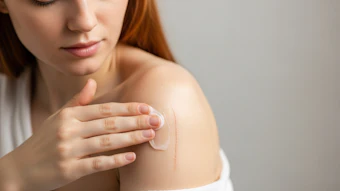
Skin care is experiencing a fresh chapter in innovation with the rise of miniproteins – a relatively new frontier for beauty. These three-dimensional amino acid structures are engineered to tackle specific skin concerns like collagen production, hydration and repair. Building on the popularity of peptides, miniproteins take efficacy a step further, enabling more targeted and effective results.
Growing interest in them is reflected in market projections – the miniprotein skin care segment is expected to expand from US $3.4 billion in 2025 to $6.6 billion by 2035, driven by demand for advanced, science-backed solutions.1 In addition, brands Like Trinny London, Peach & Lily and Medik8 tout the benefits of miniproteins to target fine lines and wrinkles and improve skin elasticity.
This article is only available to registered users.
Log In to View the Full Article
Skin care is experiencing a fresh chapter in innovation with the rise of miniproteins – a relatively new frontier for beauty. These three-dimensional amino acid structures are engineered to tackle specific skin concerns like collagen production, hydration and repair. Building on the popularity of peptides, miniproteins take efficacy a step further, enabling more targeted and effective results.
Growing interest in them is reflected in market projections – the miniprotein skin care segment is expected to expand from US $3.4 billion in 2025 to $6.6 billion by 2035, driven by demand for advanced, science-backed solutions.1 In addition, brands Like Trinny London, Peach & Lily and Medik8 tout the benefits of miniproteins to target fine lines and wrinkles and improve skin elasticity.
Initially rooted in biotechnology and medical research, miniproteins are now carving out a pivotal role in modern beauty. To better understand this shift, we’ve gathered insights from three key experts.
Daniel Isaacs is chief product officer and director of research for Medik8, a L’Oréal Luxe brand leveraging miniproteins for advanced anti-aging products. Dendy Engelman, M.D., is director of dermatology, Mohs surgery and laser medicine at Shafer Clinic, NY, and is also a global ambassador and advisor for Medik8. And Sergio Manzano is the chief business officer for Activen SA, an ingredient innovator leading the development of miniproteinsa for the cosmetic and beauty space. Together, they reveal how miniproteins are shaping the next era of skin care.
Translating Miniproteins from Medicine to Beauty
According to Daniel Isaacs, chief product officer and director of research for Medik8, miniproteins are a relatively new frontier for our industry. “[These] molecules … exist in nature and are really only now being deeply explored within skin care,” he explains. “Miniproteins emerged from broader scientific research in biological medicinal sciences, where they are being studied for a wide range of potential health applications, including autoimmune diseases and cancer treatment.”
“[Miniproteins] have … been extensively investigated in the pharmaceutical field, notably in areas such as oncology, and are now emerging as promising actives for dermo-cosmetic applications,” Sergio Manzano, business head for Activen SA, adds. “[They] were discovered at the intersection of natural biodiversity exploration and major advances in molecular biology.
“Early research identified them in organisms such as venomous animals, plants, microbes and marine species, where very small yet highly stable proteins serve functions related to defense, signaling or communication,” Manzano continues. “In parallel, technological breakthroughs, including high-throughput sequencing, protein structure prediction and advanced analytical tools made it possible to detect and characterize these small, highly folded molecules, which had previously gone largely unnoticed.”
Unfolding Miniprotein Structure and Function
What sets miniproteins apart from peptides and regular proteins? Isaacs reports: “Structurally, they sit between peptides and proteins because they contain the same building blocks (amino acids), but they form compact 3D-folded structures like full-sized proteins.” He adds that they’re small but mighty, with the ability to deeply penetrate the skin. “[They] are similar to peptides in that they have the same build-up but are very different in their shape and structure.”
Manzano expands on their physical configuration. “Miniproteinsa are small, highly structured protein scaffolds… Their defining characteristics are their exceptional structural stability and their high biological efficacy. … While most cosmetic peptides are linear chains of amino acids, miniproteins adopt well-defined three-dimensional tertiary structures. This folded architecture confers markedly higher stability, notably through increased resistance to enzymatic degradation, which in turn supports stronger and more durable biological activity.”
Per Manzano, miniproteins typically range from 1 to 10 kDa, corresponding to approximately 10 to 100 amino acids. “For technical and manufacturing reasons, the miniproteinsa developed at Activen typically comprise between 10 and 25 amino acids…, [which still maintains] a compact and stable three-dimensional structure.”
How Miniproteins Deliver Multimodal Functionality
According to Isaacs, the secret to miniproteins’ high performance is their adaptability. “…The 3D structure allows miniproteins to fit into a wider variety of receptors and [to] activate cells in a more complex way than linear, simple structures of traditional peptides,” he explains, noting that tapping into this science for beauty and skin care has improved the efficacy of products by enhancing their penetration.
 Medik8’s Liquid Peptides Advanced MP Serum is clinically proven to improve the look of deep-set wrinkles; a) before treatment; b) after 8 weeks of treatmentImage courtesy of Medik8
“In Medik8’s Liquid Peptides Advanced MP Serum, one miniprotein rapidly smooths expression lines by interacting with receptors involved in nerve-muscle signaling, while another boosts collagen, elastin and hyaluronic acid production,” Isaacs adds.
Dendy Engelman, M.D., director of dermatology, Mohs surgery and laser medicine at Shafer Clinic, NY, and global ambassador and advisor for Medik8, furthers: “miniproteins can interact with cells in more targeted ways because of their defined structure. They can stimulate cellular pathways, support regeneration, repair or protect skin and hair.” She emphasizes that for beauty, this means they have versatile benefits, “…so I’m sure that we will be seeing them incorporated into new skin and hair care formulas,” she adds.
Manzano delves deeper into their mechanisms. “As described by Crook, et al., in ‘Miniproteins as a Powerful Modality in Drug Development,’2 naturally occurring miniproteinsa can fulfill several distinct roles, including acting as agonists, antagonists, steric blockers, molecular ferries or molecular connectors.”
What’s more, Manzano underscores their superior target affinity and selectivity, compared with linear peptides. “Their compact, folded architecture enables modes of molecular interaction that linear chains simply cannot achieve, resulting in enhanced functional versatility and biological precision,” he writes.
“Equally important, [as previously stated], their intrinsic structural stability protects them from enzymatic degradation, significantly improving their bioavailability and sustaining their biological activity over time – a fundamental driver of the high performance we attribute to this class of actives.” Per Manzano, these attributes make miniproteins particularly relevant for beauty and skin care applications.
Besides skin care, Manzano points to their potential for hair and scalp care. “Beyond their natural affinity for hair fibers … the most compelling potential lies in their targeted action on scalp and hair follicle biology. By interacting with specific biological pathways involved in processes such as hair loss modulation, miniproteinsa could support more advanced and precise treatment strategies.”
Miniproteins Built for Beauty
To build miniproteinsa for beauty and personal care, Manzano describes Activen’s approach:
- Identification of natural or bio-inspired scaffolds: Research teams, primarily comprising bioinformaticians, identify naturally occurring miniproteinsa using the company’s Silicos miniprotein database and discovery platform.
- Chemical synthesis: Selected candidates are synthesized using pharmaceutical-grade chemical processes to ensure compact, stable architectures are created in a controlled and reproducible manner.
- NGS-enabled screening: Candidates undergo large-scale performance screening using Next Generation Sequencing (NGS) technologies, enabling rapid refinement and identification of the most promising molecules.
- Cosmetic compatibility evaluation: In-depth evaluations according to cosmetic compatibility criteria are carried out, e.g., to determine penetration, stability, safety and formulation compatibility.
“To date, Activen has developed two miniproteins … one targeting rapid wrinkle smoothingb and … another c designed for deep skin restructuring,” Manzano writes.
The wrinkle-smoothing activeb is a 22–amino-acid μ-conotoxin, said to deliver facial line relaxation within 30 min by modulating the Nav1.4 channel at the neuromuscular junction. The skin restructuring agentc reportedly acts by modulating the TGF-β receptor deeply within the extracellular matrix, correcting visible skin sagging in 14 days.
 Medik8 Liquid Peptide Advanced MP SerumImage courtesy of Medik8
Medik8 has incorporated such technologies in its Liquid Peptide Advanced MP Serum. “The [expression line miniproteins] help to relax and smooth fine lines, and since they can penetrate so deeply, they visibly reduce wrinkle depth, showing results in just 10 minutes,” Isaacs explains. “[The growth factor miniprotein] helps to boost collagen, elastin and the skin's hyaluronic acid levels, ultimately making the skin firmer and smoother,” he adds.
“I like Liquid Peptides Advanced MP Serum because it’s truly one-of-a-kind, drawing inspiration from aesthetic treatments,” Engelman observes. “While it complements professional procedures, it also helps smooth fine lines and plump the skin, delivering visible results that are comparable to in-office treatments.
“This formula goes beyond typical peptide serums with its inclusion of [dual miniproteins], which are perfectly crafted to fit into cell receptors that are responsible for producing collagen, elastin and hyaluronic acid,” Engelman writes.
Meeting the Demand for Dermocosmetics
Miniproteins also fulfil the consumer demand for science-backed beauty. “They show a genuine scientific breakthrough, with clinically proven effects on both rapid and long-term wrinkle improvement,” Isaacs observes. “Their proven ability to penetrate the skin and show truly impressive results will support consumer interest in high-performance, research-driven beauty products.”
Engelman adds, “Patients are looking for products that do a lot more than just surface-level work, especially at the price point that most formulations are at today. [This is] why I recommend looking into formulations that include miniproteins for lasting results.”
Manzano concurs: “Miniproteinsa are fully aligned with the dermocosmetic trend, driven by consumers’ desire to access cutting-edge science to achieve levels of efficacy approaching those of invasive techniques.” He also highlights the ability of his company’s discovery platform to identify the most effective miniproteins for a given biological target.
“These miniproteins potentially outperform conventional peptide efficacy standards and ultimately deliver an unmatched boost of efficacy to the skin and scalp.” What’s more, Manzano emphasizes how their highly targeted, specific modes of action enable a more precise, refined biological response, combining safety, stability and a robust scientific rationale.
Future Outlook for Miniproteins in Beauty
According to Manzano, miniproteinsa represent a new frontier in cosmetic innovation, with far-reaching implications for both skin and hair health. Their development is also reshaping how active ingredients are discovered, designed and formulated.
“… Advances in bioinformatics and NGS-based technologies make it possible to identify and screen thousands of miniproteinsa with high precision,” he explains. “This opens the way to faster discovery cycles, the development of tailor-made miniproteins addressing specific cosmetic claims or previously unmet dermatological needs, and the creation of increasingly sophisticated libraries of active ingredients. Together, these capabilities support a continuous pipeline of novel actives that are both nature-inspired and scientifically optimized.”
In addition, miniproteins support growing demand for effective and minimalist beauty. “Today’s consumers expect fewer ingredients but with higher performance,” Manzano writes. “Thanks to their multifunctionality, high potency at low doses and strong compatibility with clean formulation principles, miniproteinsa enable brands to simplify formulas while enhancing efficacy…”
Looking ahead, Manzano sees the potential of miniproteinsa extending to unmet dermatologic concerns. “By enabling highly targeted and biologically relevant mechanisms of action, future generations of miniproteins could address … pigmentation disorders, severe xerosis, chronic redness, as well as the hallmarks of aging,” he projects. “The ability to tackle complex and previously difficult-to-manage conditions further reinforces the role of miniproteins as transformative actives, capable of reshaping the landscape of dermocosmetic innovation in the years to come.”
Footnotes
a Miniproteins is a registered trademark and product of Activen SA.
b The XEP-018 Miniprotein (INCI: Mu-conotoxin CnIIIC) and
c XEP-716 Miniprotein (INCI: Not Provided) are products of Activen.
References
1.Fact.MR. (2025, Aug). Miniproteins skincare market. Available at https://www.factmr.com/report/miniproteins-skincare-market.
2. Crook, Z.R., Nairn, N.W. and Olson, J.M. (2020). Miniproteins as a powerful modality in drug development. Trends Biochem Sci. Available at https://pubmed.ncbi.nlm.nih.gov/32014389/.