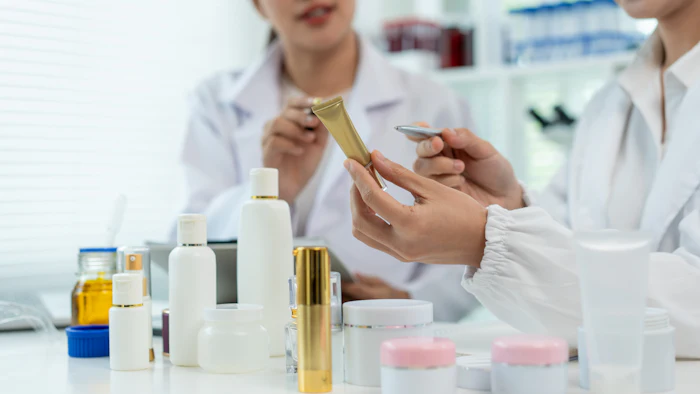
Compliance with the ingredient restrictions and concentration limits established by legislation is necessary, but it is not sufficient on its own to demonstrate the safety of a cosmetic product. The assessment must also take into account the conditions of use, exposure, raw material quality, formula stability and microbiological protection.
These factors are closely interconnected. A change in composition may affect stability or the effectiveness of the preservation system, while the choice of packaging can influence storage conditions and the amount of product dispensed. Assessing each element in isolation, without considering how they interact, may leave important issues unresolved.
In cosmetic product development, the formal safety assessment is often completed when the formula has already been finalized and the main tests have been performed. Involving the safety assessor earlier makes it possible to identify potential issues while changes can still be made to ingredient selection, supplier documentation or the packaging system, avoiding more costly modifications at later stages.
This is the principle behind Safety by Design: rather than assessing a product's safety only after development has been completed, safety considerations are integrated into formulation decisions from the outset.
The scientific principles underlying risk assessment are shared internationally. They include hazard identification, exposure estimation under intended and reasonably foreseeable conditions of use, and risk characterization, taking uncertainties into account. Differences between markets mainly concern regulatory requirements, recognized methods and documentation, while international cooperation contributes to the development of common approaches to chemical safety assessment1.
For cosmetic products, these principles translate into the collection and interpretation of data relating to raw materials, the finished formula, stability, microbiological protection and packaging. The European Cosmetics Regulation and the guidance issued by the Scientific Committee on Consumer Safety (SCCS) provide a framework for organizing this assessment and documenting its results2-4. The US Food and Drug Administration (FDA) also emphasizes the importance of existing safety information and the need for additional testing when the available data are insufficient5.
The key question, therefore, is not simply whether the ingredients are permitted and used within the applicable limits. It is whether the available evidence is sufficient to demonstrate that the product is safe under its actual manufacturing, storage and use conditions.
Defining Exposure Before Selecting Ingredients
The product brief should establish where the cosmetic will be applied, the intended user population, the amount likely to be used and the frequency of application. It is important, for example, to distinguish between a rinse-off product, which is removed by rinsing, and a leave-on product, which remains on the skin. Packaging and the intended shelf life also help define the exposure scenario to be assessed.
This distinction has practical consequences for formulation. An ingredient used in a rinse-off cleanser may require a different assessment if incorporated into a leave-on cream. However, even between leave-on products intended for the face and those intended for the body, there are substantial differences due to the larger application surface area and the resulting greater exposure. An ingredient with a high level of chronic toxicity cannot be used in a body care product at the same concentration as in a facial product.
A typical example is butyloctyl salicylate, an ester with SPF-boosting properties. Based on the toxicity data available in the literature, its concentration in a body sunscreen, where exposure to the ingredient is significantly greater, must be considerably lower than in a facial sunscreen or a sunscreen intended for application to limited areas of the body.
Exposure depends not only on the ingredient concentration but also on the chokniti at Adobe Stock
Exposure estimation may need to account for the simultaneous use of multiple products and specific scenarios, such as cosmetic use in children. The SCCS Notes of Guidance provide models and reference values that support these assessments. The parameters used must nevertheless be appropriate for the product and population under consideration, rather than being applied automatically to scenarios for which they were not developed3.
Early involvement of the safety assessor helps identify missing data before the formula is finalized. This collaboration is particularly valuable for products intended for specific user groups or featuring application methods that may significantly affect exposure.
A significant example is provided by powder cosmetics, for which a review of the formulation alone may not be sufficient to identify all potential exposure risks. In particular, for powder products intended for facial application, determining the particle size distribution and the proportion of airborne particles generated during use through specific analytical testing can help assess potential inhalation exposure and identify appropriate risk mitigation measures. These may include selecting raw materials with suitable physicochemical properties or defining appropriate conditions of use for the product.
When carried out at an early stage, such assessments support the development of intrinsically safer products and provide a more robust demonstration of their safety for consumers.
Following the Formula Through its Shelf Life
Toxicological information on individual raw materials provides a starting point, but it does not necessarily describe how the finished formula will behave. The combination of ingredients, the presence of impurities and potential interactions between components can affect product characteristics and aspects relevant to safety. European legislation requires these factors to be addressed as part of the cosmetic product safety report2.
During storage, pH, temperature, light and oxygen can promote chemical transformations that alter the original composition. Stability studies should therefore do more than verify the product's appearance or compliance with physical specifications. They should also be designed around the potential issues associated with the specific formulation.
A change in color or odor, for example, may indicate a degradation process that warrants further investigation. It does not automatically mean that the product has become unsafe, just as an unchanged appearance does not rule out every possible chemical alteration. The significance of the change must be determined by identifying its cause and, where necessary, conducting targeted analyses.
For example, products containing vitamin C tend to develop a yellow-orange discoloration over time. This occurs because ascorbic acid is highly susceptible to oxidation, which can lead to yellow or orange discoloration even when only a small proportion of the vitamin C has degraded, despite formulation strategies designed to minimize this phenomenon. Compared with other polyphenolic or flavonoid antioxidants, ascorbic acid terminates the free radical chain reaction through a disproportionation reaction, and the resulting products, such as dehydroascorbic acid (DHA) and 2,3-diketogulonic acid, are non-damaging and non-radical species6.
Therefore, partial degradation of vitamin C is more closely associated with changes in the product's organoleptic properties than with a loss of safety.
Further investigations should therefore be guided by the characteristics of the formula. Collaboration between the formulator, analytical specialist and safety assessor helps identify plausible degradation pathways, select relevant analytical tests and avoid investigations that would not provide useful information for decision-making.
Assessing Ingredient Substitutions
Requests to increase the proportion of natural ingredients, simplify the INCI list or replace substances perceived as controversial can significantly influence cosmetic product development. These objectives may be legitimate from a formulation or commercial perspective, but they do not automatically lead to an improved safety profile.
Raw materials with vegetal origin illustrate this challenge. Their composition may vary depending on the species, origin and manufacturing processes. In addition to the constituents responsible for the desired effect, potential contaminants, adulteration and residues must also be considered. Depending on the raw material and its intended use, relevant factors may include skin irritation, sensitization and phototoxicity7,8.
For example, when replacing a synthetic ester with a vegetable oil, it is essential to consider the increased risk of oxidation and provide adequate protection through the use of antioxidant ingredients to prevent peroxide formation.
Similar caution is needed when considering the concept of clean beauty. A study of products marketed according to this approach identified ingredients with recognized allergenic potential, including fragrances and botanical substances9. A product's commercial positioning alone therefore cannot predict its tolerability.
Ingredient substitution should start with the function the ingredient needs to perform in the formula. Two substances may provide similar performance while differing in the concentrations required, impurities, toxicological profiles, compatibility with other components or contribution to preservation. An alternative that requires a higher concentration, for example, may change exposure, while different compatibility with the preservation system may necessitate additional testing.
Comparisons between alternatives should therefore consider both their advantages and potential trade-offs, based on the available evidence. An ingredient's natural or synthetic origin and commercial reputation cannot replace this assessment.
 colnihko at Adobe Stock
Designing Antimicrobial Protection
Reducing preservative concentrations may be a formulation objective, but the resulting product must still provide adequate microbiological protection throughout its intended period of use. Contamination can compromise product quality and, under certain conditions, pose a risk to consumers10.
Preservation efficacy does not depend solely on the selected preservative. pH, water activity, formula composition, raw material quality and manufacturing hygiene all contribute to the overall level of protection. Packaging can also influence the likelihood of contamination during use.
ISO 11930 establishes criteria for evaluating the antimicrobial protection of cosmetic products through preservative efficacy testing and microbiological risk assessment11. The verification strategy should be appropriate to the characteristics of the product and the level of protection required.
Multifunctional ingredients and packaging designed to limit exposure to the environment can contribute to preservation. However, their use does not automatically demonstrate that the formula is adequately protected. Efficacy must be verified in the actual system, taking into account interactions between ingredients and the conditions of use.
The claim “preservative-free,” finally, is not evidence of microbiological safety. What matters is the product's ability to maintain adequate protection under the intended conditions, regardless of the strategy used to achieve it.
Furthermore, it is important to consider that conventional preservatives are ingredients whose toxicological profiles have been extensively assessed. The regulatory limits established for these substances are based on the evaluation of the available toxicological data.
By contrast, so-called non-preservative preservatives are substances whose safety must be assessed by the safety assessor, who needs to establish an adequate margin of safety based on the available toxicological data. In some cases, this assessment may result in significantly lower maximum use concentrations, particularly in products associated with high levels of consumer exposure.
It is therefore advisable to carry out a preliminary safety assessment of these substances at the formulation development stage. This helps prevent the need for reformulation due to the identification of an unsafe ingredient concentration at the end of the development process, when most of the testing activities, particularly the preservative efficacy test (challenge test), may already have been completed.
Evaluating the Formula and its Packaging Together
Packaging helps determine the conditions under which a cosmetic product is stored and used. Light and oxygen permeability, contamination risk, the amount dispensed and potential interactions between the formulation and packaging materials can affect product quality and safety assessment. Potential migration of substances from the container into the product is another aspect that may require investigation12,13.
For example, products with a high content of lipophilic substances may exhibit a strong solvent effect on plastic materials. In certain cases, this may lead to the extraction of impurities with potential sensitizing properties from the coatings used to color the outer surface of the packaging.
Compatibility testing should use a packaging system representative of the one intended for commercialization. The tests required depend on the materials in contact with the formula, storage conditions, intended shelf life and dispensing mechanism.
The container can also influence the amount of product used per application. A comparative study reported differences in product consumption ranging from approximately 5% to 23% for the products examined. These findings cannot be generalized to every cosmetic product, but they illustrate why the dispensing system may affect exposure estimates14.
Choosing between a jar, a pump bottle or another type of container should therefore not be treated as a purely aesthetic or commercial decision. Packaging should be selected and evaluated in relation to the formulation and intended use scenario before the product is finalized for the market.
Using Predictive Tools During Development
Non-animal methods can help address information gaps and identify issues requiring further investigation before the final formula is defined. Integrated Approaches to Testing and Assessment (IATA) provide frameworks for combining existing evidence with data from different methods, including non-animal approaches. Computational methods can contribute by estimating chemical properties and potential hazards1.
The SCCS Notes of Guidance also address New Approach Methodologies (NAMs), defined approaches, in silico methods and Next Generation Risk Assessment (NGRA)3. The OECD QSAR Toolbox supports the identification of chemical hazards and the filling of data gaps through chemical grouping, read-across and predictive methods, including applications to skin sensitization15.
AI can help organize information, identify patterns in datasets and prioritize substances or questions requiring further investigation. Its usefulness, however, depends on data quality and the model’s applicability to the assessment question. Predictions outside the model’s applicability domain require particular caution and may be unsuitable for supporting a safety decision.
Integrating Safety by Design into the Development Process
Integrating Safety by Design does not mean creating a separate procedure. It means incorporating safety criteria into decisions already made during development: defining the product brief, selecting raw materials, planning stability studies, designing the preservation strategy and choosing the packaging.
The main benefit is practical. A potential issue identified while the formula is still under development can be addressed by changing the ingredients or packaging. The same change, requested at a later stage, may require tests to be repeated and extend development timelines. Achieving this requires timely communication between the formulator, safety assessor, microbiologist and packaging specialist, together with clear documentation of decisions and the reasoning behind them.
The same discipline should carry through to communication. Terms such as natural, preservative-free and microbiome-friendly must be supported by evidence consistent with the meaning of the claim and the characteristics of the finished product. In Europe, the common criteria for the justification of cosmetic claims provide a reference framework for this purpose16.
The key is to anticipate safety-related questions rather than addressing them only after the formulation has been completed. Defining exposure, assessing stability, demonstrating preservation efficacy and evaluating packaging help establish a stronger evidence base for the final safety assessment. The regulatory framework establishes the requirements that must be met; the development process must provide the evidence needed to demonstrate that the product is safe under its intended conditions of use.
References
- Organization for Economic Co-operation and Development (OECD). Assessment of chemicals. https://www.oecd.org/en/topics/assessment-of-chemicals.html (accessed 6 October 2026).
- European Union. Regulation (EC) No 1223/2009 of the European Parliament and of the Council on cosmetic products. In particular Article 3 and Annex I, Part A and Part B, concerning the cosmetic product safety report, exposure, impurities and interactions.
- Scientific Committee on Consumer Safety (SCCS). Notes of Guidance for the Testing of Cosmetic Ingredients and Their Safety Evaluation – 12th Revision, SCCS/1647/22, adopted 15 May 2023; corrigenda October and December 2023. European Commission.
- European Commission. Scientific Committee on Consumer Safety (SCCS): scientific opinions and guidance on the safety of cosmetic ingredients.
- U.S. Food and Drug Administration (FDA). Product Testing of Cosmetics. https://www.fda.gov/cosmetics/cosmetics-science-research/product-testing-cosmetics (accessed 6 October 2026).
- Davey M.W., Van Montagu M., Inze D., Sanmartin M., Kanellis A., Smirnoff N., Benzie I.J.J., Strain J.J., Favell D., Fletcher J. Plant L-ascorbic acid: Chemistry, function, metabolism, bioavailability and effects of processing. J. Sci. Food Agric. 2000;80:825–860.
- Antignac E, Nohynek GJ, Re T, Clouzeau J, Toutain H. Safety of botanical ingredients in personal care products/cosmetics. Food and Chemical Toxicology. 2011;49(2):324–341.
- Bruusgaard-Mouritsen MA, et al. Natural ingredients in cosmetic products—A suggestion for a screening series for skin allergy. Contact Dermatitis. 2020;83(4):251–270.
- Li DG, et al. Natural Is Not Always Better: The Prevalence of Allergenic Ingredients in “Clean” Beauty Products. Dermatitis. 2022.
- Lundov MD, Moesby L, Zachariae C, Johansen JD. Contamination versus preservation of cosmetics: a review on legislation, usage, infections, and contact allergy. Contact Dermatitis. 2009;60(2):70–78.
- International Organization for Standardization (ISO). ISO 11930:2019. Cosmetics — Microbiology — Evaluation of the antimicrobial protection of a cosmetic product.
- Murat P, et al. Assessment of targeted non-intentionally added substances in cosmetics in contact with plastic packagings. Analytical and toxicological aspects. Food and Chemical Toxicology. 2019;128:106–118.
- Cosledan S, et al. Development of a HS-SPME-GC-MS method for the analysis of phthalates in glycerin and liquid paraffin: application to safety evaluation of cosmetic packagings. International Journal of Cosmetic Science. 2020.
- Gomez-Berrada MP, et al. Influence of the container on the consumption of cosmetic products. Food and Chemical Toxicology. 2017;108:162–167.
- European Chemicals Agency (ECHA). QSAR Toolbox for animal-free assessment of skin sensitization; information on defined approaches and computational methods. https://qsartoolbox.org/ (accessed 6 October 2026).
- European Commission. Commission Regulation (EU) No 655/2013 laying down common criteria for the justification of claims used in relation to cosmetic products.