The arrival of bemotrizinol (BEMT) in the U.S. sunscreen market is already moving beyond a regulatory story and into a formulation and product-development story. Following the FDA’s June approval of BEMT, dsm-firmenich’s announcement of Parsol Shield established the new filter as a newly available tool for U.S. formulators. Ultra Violette then became the first U.S. brand to commercialize a BEMT-containing sunscreen. Now, Neutrogena is bringing the technology into two mainstream facial SPF launches.
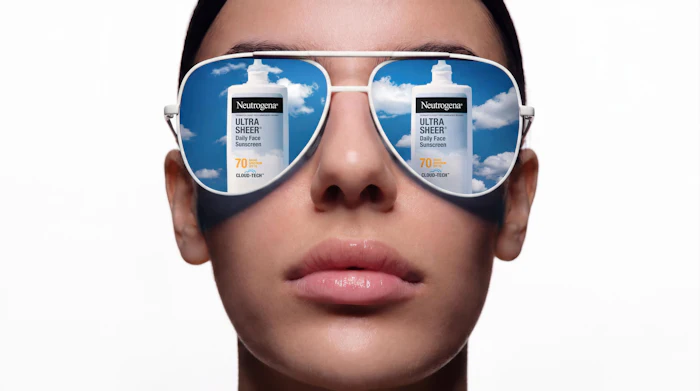
Neutrogena’s new Cloud-Tech technology combines BEMT with its existing Helioplex360 system in Clear Face Sunscreen SPF 60 and Ultra Sheer Daily Face Sunscreen SPF 70. The formulas pair the new filter with skin care ingredients including niacinamide and Neutrogena’s patented Micro-Peptide Technology, targeting acne-prone skin and visible signs of aging, respectively.
Neutrogena is linking BEMT to the aesthetic problem that has long challenged high-SPF products: delivering substantial protection without creating a heavy, greasy or difficult-to-layer formula. The company says Cloud-Tech is designed to provide a weightless, fast-drying, silk-finish experience and describes the Ultra Sheer formula as 50% lighter on skin than leading sunscreens.
That connects directly with the rationale behind dsm-firmenich’s Parsol Shield launch. The supplier has emphasized BEMT’s broad-spectrum protection, photostability, formulation flexibility and ability to support silky, lightweight textures. It also points to BEMT’s existing approval in other global markets as an opportunity to simplify global formulation strategies now that the ingredient is available in the U.S.
Ultra Violette demonstrated a different early application of that flexibility. Its Unblock Screen SPF 50 combines BEMT with zinc oxide and skin care-oriented ingredients for acne-prone, oily and reactive skin. The brand is already planning a second BEMT-powered U.S. sunscreen, Fave Screen SPF 50, for January 2027, featuring 5% BEMT alongside niacinamide and vitamins C and E.
Taken together, the three developments suggest that the immediate opportunity around BEMT is the ability to rethink the trade-offs among UV protection, texture, skin care functionality, formulation space and consumer experience. Neutrogena’s entry is particularly notable because it takes those attributes from a specialty/imported-sun care proposition into a large-scale mass-market facial sunscreen portfolio.
For formulators, the next question is how broadly BEMT will reshape U.S. sunscreen formats. With the regulatory barrier cleared, early launches are already pointing toward lighter textures, skin care-infused SPF, higher-protection facial products and potentially greater alignment between U.S. and international sunscreen formulation strategies. The first wave is now underway; the more consequential shift may be the range of products that formulators build around the new filter next.