In the United States, the skin care market is being reshaped by a powerful middle ground: masstige skin care. Positioned between mass and prestige, masstige brandsa are now dominating the U.S. skin care segment, per Circana data—outperforming both entry-level and luxury players as consumers recalibrate their spending in a K-shaped economyb. As inflation fatigue, selective splurging and value-conscious upgrading converge, American beauty shoppers are no longer trading strictly up or down. Instead, they are trading across—seeking clinically credible formulations, elevated branding and attainable price points that feel like smart investments rather than indulgences.
 As inflation fatigue, selective splurging and value-conscious upgrading converge, American beauty shoppers are no longer trading strictly up or down. Instead, they are trading across—seeking clinically credible formulations, elevated branding and attainable price points that feel like smart investments rather than indulgences.m-art at Adobe Stock
In this report, Global Cosmetic Industry explores how masstige skin care came to dominate the U.S. market, what it reveals about evolving consumer behavior, and how beauty brands can pivot to capture growth in a K-shaped economy—whether by moving up, moving down or strategically meeting consumers where they now feel most comfortable spending.
Masstige Brands Drive Growth in a K-Shaped Economy
 In the first nine months of 2025, U.S. prestige skin care sales rose a modest 1% year-over-year to reach $6.7 billion, per Circana, with unit sales outpacing dollar growth—an indication of heightened promotional activity and more cautious premium spending. wedmoments.stock at Adobe Stock
Within the prestige category, facial skin care—the largest segment in the U.S. market—saw incremental growth, driven primarily by e-commerce, as consumers increasingly turn online for replenishment and product discovery. Body care and sun care emerged as the fastest-growing skin care segments. In mass retail, face serums and facial moisturizers ranked among the fastest-growing product categories, reflecting sustained interest in results-oriented, accessible solutions.
Against this backdrop, masstige skin care brands continue to outperform both mass and prestige, posting 14% nine-month growth through September 2025. The ability to balance perceived efficacy, elevated branding and attainable price points positions masstige to compete and win in an increasingly K-shaped beauty economy.
The Brands Positioned to Thrive in a K-shaped Economy
 "There is so much synergy between our brand, the brands in the Silas portfolio and L Catterton's deep strategic knowledge of the category,” said YSE Beauty founder, Molly Sims, when her brand's latest funding was announced. Sarah Holt for YSE
It’s no surprise, then, that in December 2025 YSE closed a $15 million Series A funding round led by Silas Capital, with participation from L Catterton and existing investors Willow Growth Partners and Halogen Ventures.
"Molly's approachable, yet authoritative voice has been a key driver in building the loyal and engaged community supporting the incredible momentum for YSE Beauty," said Brian Thorne, partner at Silas Capital. "Leveraging her insider network of dermatologists, estheticians and makeup artists, she has curated a lineup of multi-functional skin care-meets-makeup essentials that cater to an underserved Gen X customer that demands results-driven beauty. We're thrilled to partner with Molly for this next chapter, supporting both the brand's impressive e-commerce momentum, as well as its quickly scaling wholesale expansion with Sephora."
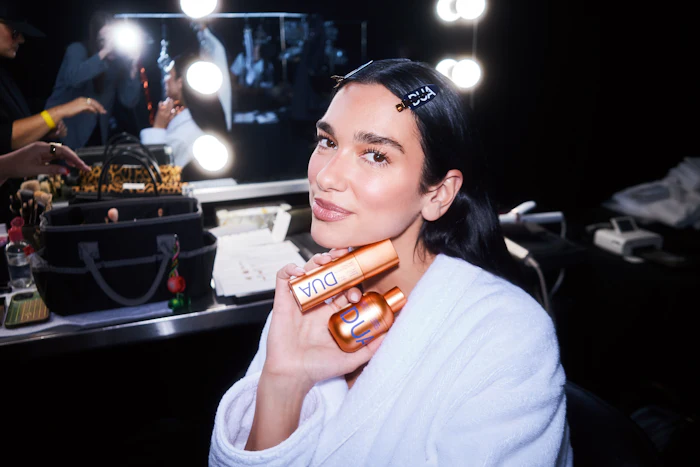
DUA, a skin care line created by Dua Lipa and Augustinus Bader Science, also targets consumers on the upward arm of the K, particularly those who continue to invest in high-performance, science-led skin care as a form of long-term self-maintenance rather than discretionary luxury. Priced in the accessible-to-upper prestige range and built on Augustinus Bader’s proprietary TFC5 technology, the brand offers clinical credibility, preventative positioning and routine simplification, appealing to shoppers who are consolidating routines but not compromising on efficacy. DUA demonstrates how premium, celebrity-founded brands can still potentially gain traction by reframing skin care as an essential, performance-driven investment—supported by trusted science—rather than an aspirational indulgence.
 REMEDY fits into the K-shaped economy by capturing consumers on the “downward” arm who are trading down in price but not in standards, seeking dermatologist-backed efficacy at mass-accessible price points.REMEDY
The brand recently launched its Daily Defense 15% Vitamin C Complex ($27.99) as part of a nationwide expansion at Target in the United States. Other exclusives at the retailer include the Remedy Hand & Cuticle Repairing Butter Cream with Retinol ($17.99) and Remedy Derm Dissolve Cleansing Balm ($17.99), as well as a Morning Protocol Bundle ($19.99) featuring the Daily Defense Serum, Cream-to-Foam Cleanser and Rich Cream Moisturizer.
At Target, REMEDY’s strategy centers on leveraging national scale to lower, rather than raise, prices, reportedly using Target’s margin structure to expand access to dermatologist-developed skin care without sacrificing efficacy or transparency. By maintaining clear, concern-led labeling and simplified routines while avoiding the premium markups typically associated with mass retail expansion, REMEDY is seeking to reinforce its challenger positioning and strengthen consumer trust. The approach reflects a deliberate focus on affordability, clarity and clinical credibility as core growth drivers in today’s polarized beauty market.
5 Keys to the K-shaped Skin Care Market
- Position for the middle ground: Masstige brands are dominating growth by balancing efficacy, branding, and attainable price points, appealing to consumers trading across rather than strictly up or down in a polarized market.
- Simplify routines and highlight results: Consumers—whether on the upward or downward arm of the K—favor products that deliver visible benefits with minimal steps, emphasizing multifunctionality and clinical credibility.
- Leverage retail and digital channels strategically: E-commerce remains a key growth driver, particularly for facial skin care, while selective retail expansions (like REMEDY at Target or YSE at Sephora) can amplify accessibility and brand trust.
- Align pricing with consumer expectations: Brands that use scale and strategic partnerships to maintain affordability without compromising quality—like REMEDY—can capture value-conscious shoppers and reinforce loyalty in a price-sensitive environment.
- Target and communicate to distinct consumer segments: Upward K consumers (e.g., DUA, YSE) respond to science-led, performance-driven messaging, while downward K consumers (e.g., REMEDY) prioritize value, transparency and expert-backed efficacy—highlighting the importance of tailored positioning and messaging in product development and marketing strategies.
FOOTNOTES
awww.circana.com/post/us-beauty-industry-sales-accelerate-in-q3-circana-reports
bA K-shaped economy describes an economic recovery in which different segments diverge sharply—higher-income consumers and premium categories continue to grow, while lower-income consumers and value segments struggle, creating uneven outcomes across markets and industries.