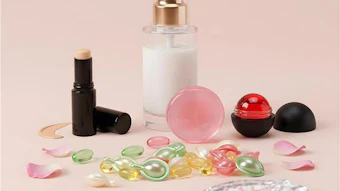
In skincare, we often speak the language of vision, focusing on glow, radiance or smooth complexion - terminology rooted in what can be seen. Yet, the most decisive sensory moment in skincare does not occur first in front of a mirror but at the interface between the skincare product and our skin. There, through touch, our expectation is either confirmed or quietly eroded. Increasingly, neuroscience and sensory science are revealing that perception is not defined by a single dominant sense but by the brain’s integration of sensory signals, into a coherent and embodied experience.
At first glance, our vision appears dominant. A large proportion of the brain is devoted to visual processing. Visual cues establish expectations before any contact with the product occurs. We “see” viscosity through transparency, richness through opacity and hydration through gloss. Product color signals freshness or cocooning. These visual cues operate fast and automatically, priming the brain with assumptions about what the product will feel like.
However, it is not vision that ultimately defines our experience. It only predicts it; touch verifies it. The moment a skin cream meets our skin, mechanosensory systems begin translating physical properties into neural signals: slip, drag, spreadability, cushioning and residue. These tactile signals are immediate, instinctive and difficult to override. While vision may suggest richness, it is the resistance felt during product application that confirms or contradicts it. Gloss may imply hydration but the residual film, or its absence, determines perceived skin feel. Our brain integrates sensory inputs automatically and continuously, combining expectation and sensation into a single perceptual reality. Touch then confirms or challenges what the brain has already forecast.
We Are Born As Multi-Sensory Beings
One of the most profound insights from sensory neuroscience is that our sensory system is not learned from scratch but pre-configured. People universally match The brain does not experience touch, vision or sound separately but integrates all sensory experiences.SHOTPRIME STUDIO at Adobe Stock
We are born with a nervous system that already links shape, texture, sound and emotional meaning. The brain does not experience touch, vision or sound separately but integrates all sensory experiences, and this has profound implications for skincare. Rounded jars instinctively signal richness and nourishment, whilst lightweight, angular pumps signal precision and lightness. Transparent packaging primes expectations of fluidity and freshness. When tactile reality aligns with these innate expectations, perception becomes fluent and believable.
Sensory signals interact by integration and super-additivity. When these align and what we see, feel, hear and smell tells the same story, the final experience becomes stronger than the sum of its parts. Each signal reinforces the others, amplifying emotional engagement and perceived efficacy. When a moisturizer looks and feels rich, spreads smoothly and absorbs well, paired with appropriate auditory and olfactory cues, it feels profoundly more effective. Conversely, when sensory signals conflict, the brain must reconcile this inconsistency. This increases cognitive load and reduces processing fluency. The experience thus becomes less convincing. The brain trusts congruence and doubts inconsistency.
The Senses Construct Our Reality
We recognize now that perception is not passive detection. The brain continuously generates predictions about incoming sensory input, based on prior experience and contextual cues. As sensory signals from the skin are interpreted in relation to this predictive processing – the expectation shapes sensory experience. The brain interprets tactile cues, such as reduced friction, increased ease of application and film formation as evidence of hydration. Aligning these cues with visual and contextual expectations, makes for an even stronger perception of hydrating efficacy.
We Feel Before We Think
Russel Jones has reminded us of Antonio Damasio’s observation that humans are “feeling machines that think, rather than thinking machines that feel”. It captures an essential truth about sensory perception. The senses provide direct access to emotional centres of the brain. Before cognitive evaluation, the sensory system has already shaped our emotional interpretation.
Touch has a special role in sensing. It does not act as an objective monitor of material reality. It is a part of a perceptual system that integrates expectation, sensation and interpretation. Texture then plays a key role in skincare acceptance. The act of product application activates mechanoreceptors transmitting signals to both the sensory discrimination and emotional processing centres. We decide how we feel first, only afterwards do we rationalize it.
Touch and The Invisible Auditory Layer
Touch is influenced by more than direct physical contact. Every interaction between skincare products and our skin produces a little noticeable sound - the resistance of a pump, the closure of a lid, the friction between fingers and skin. These auditory signals also contribute to tactile perception, often without our conscious awareness. Experimental manipulation of friction sound alone, without altering anything else, can cause people to perceive their skin as drier or smoother. Therefore, tactile perception is inherently multisensory. Touch is not experienced through the skin alone but through the brain’s integration of other invisible sensory signals contributing to the belief in the product's efficacy.
 Every interaction between skincare products and our skin produces a little noticeable sound.Lastwizard Shop at Adobe Stock
Touch Anchors Perception in the Body
Whilst visual observation is made from a distance, touch is close to the body. This distinction gives it a unique authority - it makes it inherently believable. Tactile signals originate from within the body itself, anchoring our perception in embodiment. As skin, as an active sensory interface, continuously communicates with the brain, it translates interaction into perceptual and emotional meaning. Touch does ultimately determine whether skincare claims feel true.
The Skin–Brain Axis: Where Perception Becomes Biology
As we have learnt, our sensory experience and biological response are inseparable. The skin – brain sensory dialogue is bidirectional - our brain does not simply interpret signals but regulates the skin in return. Emotional state influences skin barrier function, immune activity, inflammation and repair. Calm, pleasurable sensory experiences can support parasympathetic activation, reinforcing restoration and homeostasis.
This is where sensory congruence acquires biological significance. When tactile, visual, olfactory and auditory cues align, the experience is processed fluently and effortlessly. This reinforces emotional safety and perceptual trust – the product does not just affect the skin, it interacts with our nervous system.
This reframes skincare not merely as a topical intervention – it is a neurocutaneous experience that works simultaneously at the level of barrier biology, sensory perception, and emotional regulation. We do not experience skincare as passive recipients but embodied bodies - through a sensory system designed to integrate, interpret and respond to the world around us. Touch acts as an interface through which the brain encounters the body and skincare becomes real. Congruent sensory cues strengthen perceptual coherence and create experiences that feel intuitive, credible and emotionally satisfying. This coherence feels right and builds trust, not through claims but through embodied experience. When sensory signals align, the brain processes them efficiently, reducing cognitive effort and enhancing emotional engagement. Experiences that are easy to process feel more trustworthy, effective and desirable. This occurs below conscious awareness. Consumers may not consciously identify congruence but they can feel it.
Note: Feature based on a lecture by Society of Cosmetic Scientists (SCS) and Sensory Science Group of the Institute of Food Science & Technology (IFST). Nothing is as it seems: how sensory interactions shape perception. Joint event; February 19, 2026; Royal Society of Chemistry, London, UK.