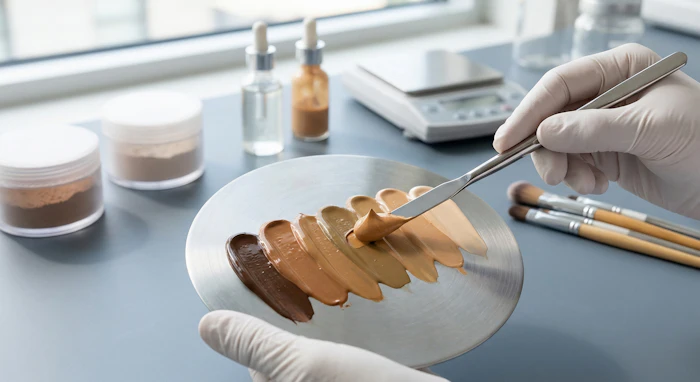
Color cosmetics cover a remarkably wide range of products, formats and performance expectations. The global market is estimated at more than $100 billion in 2026, spanning face, lip, eye and nail cosmetics and everything from liquid foundations and pressed powders to long-wear lip colors, mascaras and increasingly hybrid makeup-skin care formulations.¹ Given the breadth of the category, I focused on some of the principal testing approaches described in recent literature and tapped my expert network for additional perspective on how color cosmetics are evaluated in practice.
Modern color cosmetics are expected to do far more than simply impart color. A foundation may need to provide natural-looking, skin-like coverage while resisting transfer and oxidation; a lip product may be expected to deliver saturated color and a particular finish while remaining comfortable and resisting feathering and transfer; and mascara claims can encompass volume, length, curl retention and flake and smudge resistance. Increasingly, these products also incorporate skin care-inspired ingredients and treatment claims, further expanding both the product brief and the evaluation plan.²
For technical teams, the challenge is not a shortage of test methods, but selecting those that answer the right question. No single test can capture every aspect of a product’s performance. A useful approach starts by translating the consumer promise into what needs to be measured, then combining analytical, instrumental, expert and consumer methods that can provide those measurements. Cosmetic testing itself has evolved from largely observational approaches to standardized analytical, imaging, in vitro and computational methods.³˒⁴
From Claims to Test Methods
Before selecting a method, the technical team must define what it is trying to measure. A “long-wear” claim can mean retained color after a specified number of hours, resistance to rubbing, limited migration beyond the lip line or stability under heat, humidity, sebum and even mask contact. “Natural-looking coverage” may involve opacity, evenness, shade match, facial contrast and the visibility of skin texture. “Comfort” may encompass glide, tack, tightness, dryness and residue over time. Each version of the claim requires a different measurement and often a different test design.
Product type further determines which tests to use and what to measure. Foundation coverage can be assessed on a standardized substrate, but testing on a real face reveals how the product interacts with pores, fine lines and areas with different sebum levels. Lip color transfer can be measured on a standardized contact surface, while feathering needs to be observed at the lip border. On the other hand, the comfort of wearing the lip color is still different and must be assessed by the wearer. Mascara volume can be assessed through standardized imaging, but stiffness, flaking and the ease of building additional coats are best evaluated during actual use.
Whatever the approach, protocols should define the amount of product, applicator, number of passes, drying time, environmental conditions and measurement time points to help ensure reliable results.
The Regulatory Gate
Finished-product performance starts with control of the colorant and the formula around it. Unlike most cosmetic ingredients, color additives occupy a special regulatory position in the United States, making their selection and verification a critical part of the color cosmetics development process.
Kelly Dobos, independent cosmetic chemist, consultant and instructor at the University of Cincinnati, points out that manufacturers must first verify that a Pictiplay at Adobe Stock
Dobos also advises verifying identity and purity specifications for every color additive. Certified colors should carry an FDA-issued certification number for the batch; colors exempt from certification still require analytical controls to confirm composition and impurity limits.⁵
The analytical toolbox available to help ensure regulatory compliance includes techniques such as chromatography and mass spectrometry for identifying and quantifying colorants and impurities.⁶˒⁷ Han et al.,⁸ for example, developed an HPLC-DAD method with LC-MS/MS confirmation for 13 banned colorants and applied it to commercial products.
Instrumental Color Measurement and Imaging
Once a formula meets the relevant regulatory requirements, objective color measurement can establish whether the product delivers a reproducible shade and how that shade changes after application or wear.
Tristimulus colorimeters and spectrophotometers commonly report CIELAB coordinates, color difference (ΔE) and, for skin, measures such as the Individual Typology Angle. Reliable use depends on controlled lighting, device calibration, consistent geometry, defined anatomical sites and acclimation conditions.⁹
A ΔE value can show that two measurements differ, but the protocol must still determine whether the magnitude of that difference is perceptible or relevant to the claim.⁹
Standardized imaging can extend the analysis from a single measurement point to the spatial distribution of color across the face. Kim et al. combined a portable photography setup, ColorChecker-based calibration, spectrophotometric characterization, facial landmark detection and regional CIELAB analysis to evaluate foundation-related changes in 516 women.¹⁰
Imaging is especially useful for evaluating coverage uniformity, edge migration, fallout, flaking, clumping and changes that occur across a larger area, provided image capture remains standardized. Smartphone systems may eventually broaden remote testing, but uncontrolled lighting and camera processing can distort color. Zhang et al. showed that augmented-reality guidance, a reference target and computational correction substantially reduced color variability across lighting conditions.¹¹
Designing the Protocol Around the Claim
Wear-related claims provide a good example of how test design can be tailored to the claim. A controlled rub or scratch challenge can help screen transfer and film durability before moving to a human study. Jiang et al. applied foundation, setting spray and lipstick to artificial silicone skin, challenged the films with a friction tester under controlled conditions and quantified product loss gravimetrically. The in vitro rankings agreed with expert in vivo assessments, supporting the method as a repeatable screening tool while also demonstrating why an artificial substrate cannot fully reproduce living skin, facial movement, sweat or sebum.¹²
Foundation oxidation can be tracked through changes in L*, a* and b*; transfer can be reported as product removed from the application surface or deposited on the contact material; lip feathering can be quantified by migration beyond a defined border; and mascara wear can be documented through calibrated images of curl, flaking and under-eye smudging.
Appearance-related claims require measurements tied to the intended benefit. Standardized, color-calibrated photography and CIELAB analysis can quantify changes following foundation application, while controlled images and facial-contrast measurements can help assess makeup’s visual and perceptual effects.¹⁰˒¹³ As modern color cosmetics are expected to deliver attributes such as coverage, finish and soft-focus effects alongside wear and comfort, testing should reflect the product’s specific performance claims.² Colorimetry may then be combined with microscopy, rheology and surface measurements to build a broader picture of formulation characteristics and product performance.³
 Anna at Adobe Stock
Why Human Evaluation Still Matters
Instruments work best when what we want to measure can be clearly defined and the test conditions controlled. But human evaluation becomes essential when performance depends on application technique, skin condition, facial movement, perception or real-world use. The two approaches complement each other. An instrument may detect a small shade shift; an expert can determine whether it reads as oxidation on the face; and consumers can tell us whether the change is noticeable enough to affect their satisfaction or continued use.
Celebrity NYC makeup artist Nicolae Rita selects complexion products for his kit first by whether they look natural and skin-like, then by whether they last without creasing or lifting with a light touch. For eye and lip products, he looks for placement and control: the product should not crease, run or bleed.¹⁴ Powder eye shadows and blushes should adhere during application, provide sufficient pigment and avoid fallout, dryness and caking. These types of observations can be converted into anchored grading scales, standardized application procedures and defined checkpoints rather than left as general impressions.
Rita also notes why laboratory findings alone cannot represent the full use experience: skin type, skin condition, weather and even the day-of application can alter performance. Expert graders can reduce some variability through training and repeatable scales, while a consumer panel deliberately reintroduces the diversity of real users, routines, climates and skill levels.¹⁴ Study design should define who qualifies as an expert, how graders are trained, whether the design is blinded, which comparator is used and whether the panel reflects the intended user population.
In a study of moisturizing gel-creams, changes in the pigment influenced perceived appearance, overall acceptance and purchase intent even when measured properties and application performance were similar.¹⁵ Controlled perception research also shows the tradeoff between experimental standardization and in-use validity: professionally standardized application improves control, whereas self-application more closely reflects real behavior.¹³
New Frontiers in Testing
Looking ahead, both the challenges and the tools available to color cosmetics researchers are evolving. According to Dobos, impurity control is becoming more demanding as analytical methods detect increasingly lower concentrations. She identifies heavy metals as an area of growing regulatory scrutiny, making fit-for-purpose sample preparation and validated limits particularly important for pigment-rich matrices.⁵
At the same time, consumer interest in naturally-derived or renewable colorants is growing, yet Dobos notes that relatively few options are both approved and sufficiently stable. She does not expect the basic U.S. color-additive framework to shift soon, although she sees room for innovation in bio-based pigments and newer optical approaches. The regulatory hurdle for listing a new color additive, though, remains significant.⁵
Consumer expectations for color cosmetics are also expanding beyond traditional performance attributes. Rita observes that clients now consider not only immediate performance but also skin benefits, environmental impact, ethical positioning and sustainable packaging.¹⁴ Those concerns should be evaluated with appropriate evidence rather than collapsed into a single preference question. Product-use testing can capture comprehension and acceptance, while formulation, packaging and substantiation records address the underlying technical or responsibility claims.
Testing technologies are evolving alongside these expectations. Computer vision and machine learning are beginning to move color evaluation from description toward prediction. Dong et al. used standardized VISIA imaging, facial regions of interest and CIELAB-derived measures with machine-learning models to predict post-application skin-color parameters after complementary-color primers.¹⁶
Reviews of AI-enabled customized color cosmetics describe potential uses for automated image analysis, shade matching, virtual visualization and personalization, including systems that combine imaging with other individual data.¹⁷˒¹⁸ These tools remain dependent on the quality and diversity of their training sets, calibration across devices and lighting, clearly defined endpoints and validation against expert or instrumental measurements. A persuasive virtual try-on is not automatically a validated performance test, and a predictive model should be assessed on people and conditions not used to train it.
Conclusion
A robust evaluation program brings different types of testing together: analytical controls confirm that the colorant and formulation meet specifications; calibrated instruments and imaging quantify color, finish and wear; simulation methods provide repeatable stress testing; expert evaluation interprets application and appearance; consumer studies establish relevance in real use; and predictive tools help identify patterns across those data. The sequence can be adjusted, but the approach should always follow the claim, which in turn should be anchored in a real consumer need.
The stakes for getting that right are also increasingly high. Even as beauty remains a resilient consumer category, the marketplace has become markedly less forgiving: BeautyMatter tracked 22 beauty-brand failures in 2025, following 25 in 2024 and 28 in 2023, with additional smaller closures likely going unrecorded.¹⁹ At the same time, established companies are reassessing their portfolios; Coty, for example, has been exploring the potential sale of mass-market brands including CoverGirl and Rimmel.²⁰ In this environment, compelling packaging and marketing may win attention, but sustained success increasingly depends on products that deliver—and marketing grounded in the evidence that proves it.
References
- Grand View Research. (2026, Jun). Color cosmetics market size and share report, 2026-2033. Grand View Research. Available at Grand View Research color cosmetics market report.
- Lionetti, N. and Deola, M. (2024). Formulating Forum: Long-lasting color with treatment efficacy. Cosm & Toil.
- Rico, F., Mazabel, A., Egurrola, G., Pulido, J., Barrios, N., Marquez, R. and García, J. (2024). Meta-analysis and analytical methods in cosmetics formulation: A review. Cosmetics, 11(1) 1.
- Divya, K.J. (2024). Historical analysis of cosmetics testing development and alternatives. The Journal of Healthcare Ethics & Administration, 10 58-83.
- Dobos, K. (2026, Jul). Private communication.
- Papadopoulos, A., Assimomytis, N. and Varvaresou, A. (2022). Sample preparation of cosmetic products for the determination of heavy metals. Cosmetics, 9(1) 21.
- Guerra, E., Llompart, M. and Garcia-Jares, C. (2018). Analysis of dyes in cosmetics: Challenges and recent developments. Cosmetics, 5(3) 47.
- Han, K-M., Kim, Y.K., Seo, S., Kim, J.H., Lee, J.H., Kim, H.I. and Cho, S. (2023). Analysis of 13 banned colorants in cosmetics via liquid chromatographic and mass spectrometric techniques. Applied Sciences, 13(10) 5967.
- Ly, B.C.K., Dyer, E.B., Feig, J.L., Chien, A.L. and Del Bino, S. (2020). Research techniques made simple: Cutaneous colorimetry: A reliable technique for objective skin color measurement. Journal of Investigative Dermatology, 140(1) 3-12.e1.
- Kim, B., Lee, J., Park, S. and Suk, H-J. (2023). Method and analysis of color changes of facial skin after applying skin makeup. Vision Research, 209 108247.
- Zhang, G., Song, S., Panescu, J., Shapiro, N., Dannemiller, K.C. and Qin, R. (2023). A novel systems solution for accurate colorimetric measurement through smartphone-based augmented reality. PLOS ONE, 18(6) e0287099.
- Jiang, Y., Xu, Z., Qiu, Y., Chen, G. and Wang, S. (2023). Evaluation of the antiwear-ability/scratch-resistance efficacy of makeup products by in vitro test method application. Skin Research & Technology, 29 e13420.
- Aguinaldo, E.R. and Peissig, J.J. (2021). Who’s behind the makeup? The effects of varying levels of cosmetics application on perceptions of facial attractiveness, competence, and sociosexuality. Frontiers in Psychology, 12 661006.
- Rita, N. (2026, Jul). Private communication.
- Oliveira, W.C. and Tescarollo, I.L. (2021). Influence of color on the physicochemical and sensory properties of moisturizing cosmetics. Revista Científica Multidisciplinar Núcleo do Conhecimento, 6(2) 5-19.
- Dong, G., Liu, Y., Ran, J., et al. (2025). Applicability of complementary colors in skin tone correction for young Chinese adults based on image processing and machine learning. Journal of Cosmetic Dermatology, 24 e70566.
- Lee, J. and Kwon, K.H. (2025). Potential for the development of customized color cosmetics using artificial intelligence digital slide scanner exclusively for dermatology: A scoping review. Journal of Medical Artificial Intelligence, 8 54.
- Lee, J. and Kwon, K.H. (2025). Artificial intelligence technologies for color matching cosmetics in dermatology: A systematic review focusing on OCA2 gene direct-to-consumer genetic testing. Journal of Medical Artificial Intelligence, 8 8.
- BeautyMatter. (2026, Jun). Updated: 2026 beauty bankruptcies and closures tracker. BeautyMatter. Available at 2026 Beauty Bankruptcies and Closures Tracker.
- Reuters. (2026, Jul). Coty exits Gucci license early to raise cash for turnaround. Reuters. Available at Coty exits Gucci license early to raise cash for turnaround.