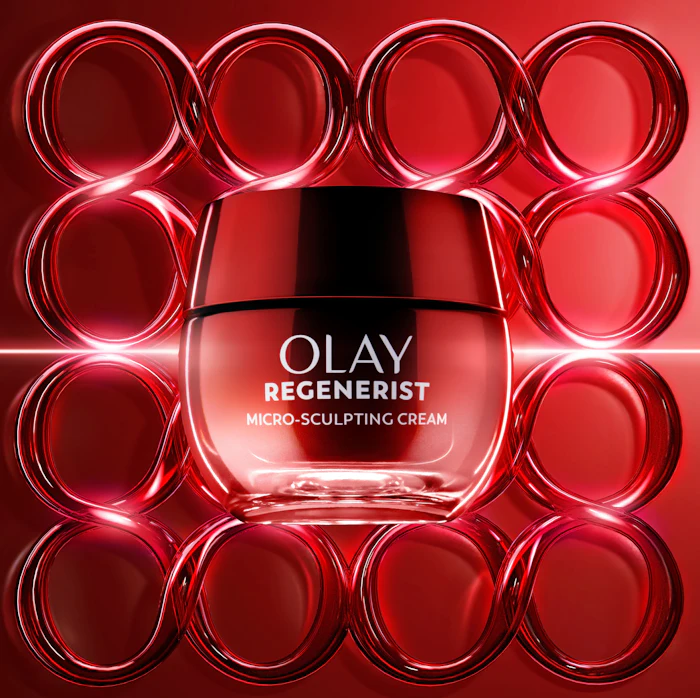
Olay Regenerist is a moisturizing cream with a long history and with more published ingredient science than almost any product on retailers’ shelves. Olay originally launched Regenerist in 2003 as an anti-aging product to complement the Olay Total Effects moisturizer. Regenerist’s selling point was its amino-peptide complex, a combination of the anti-wrinkle peptide palmitoyl pentapeptide-4 (also known as palmitoyl-lysine-threonine-threonine-lysine-serine or Pal-KTTKS)1 and niacinamide, the amide form of vitamin B3 that has anti-inflammatory and skin barrier strengthening effects.2,3
Both Pal-KTTKS and niacinamide have claims-support data that has been published in the scientific literature. The challenge for Olay was, then, how to communicate that data to the consumer. The Regenerist label reads “visibly repairs wrinkles, dullness and elasticity”,4 a claim that doesn’t communicate the level of clinical efficacy data behind the product.
Procter & Gamble operates a website that lists scientific publications supporting its key ingredients,5 but the Micro-Sculpting Cream is not mentioned. The site is oriented to scientists and medical professionals, with no attempt made to explain the science to untrained consumers. The studies listed are mostly cell and skin model work on niacinamide and retinyl propionate, with one human peptide trial that tested a Pro-X regimen.6 Olay’s own product page does link two papers, the pentapeptide trial1 and a niacinamide study, behind its ingredient statements.3
In January 2026, Olay launched a reformulated version of Regenerist. This formula contains three peptides, the original Pal-KTTKS and new palmitoyl dipeptide-7 and tripeptide-3.7 The Regenerist label and website do not cite any claim-support study on the new formula. The published papers cover ingredients and the older formula.
Product Claims Reporting to Consumers
Products make label claims for many reasons: first to educate a consumer on what the product is for, but also to show that the product can be trusted to work. Claims that reference test data or expert opinion can be effective at converting a shopper into a buyer.8 Such claims may also differentiate the product from similar competitors or justify a price higher than the cost of goods.
The label claims on a product must be trustworthy to have value. In the United States, advertising claims are regulated by the Federal Trade Commission and label claims by the Food & Drug Administration. The National Advertising Division of BBB National Programs is the industry self-regulator and anyone can file a complaint. All three organizations require that a claim be substantiated with reliable scientific evidence. However, in practice claims are not checked before they are run. Claims that are not well substantiated are rarely challenged because of the legal expenses involved.
Strong claims are often supported by scientific evidence that is difficult to explain to consumers.9 Clinical tests often use methods such as corneometry, profilometry, and image analysis that consumers are not familiar with. The strength of the test results depends on the choice of baseline, whether a placebo was used, and the statistical methods used to analyze the data. Also, instrumental performance tests and consumer perception studies both report percentage improvements, but instrumental methods provide a more objective assessment of product performance. This distinction is not always apparent to consumers, who may assume the results are directly comparable.
Even with a strong test result, it can still be challenging to convince consumers that the product is effective. The effects of cosmetic treatments may be almost invisible to the consumer, although they may show statistically significant changes to expert graders or analytical instruments. Strong claims may also run afoul of regulators. The FDA does not allow cosmetic products to claim that a product affects the structure or function of skin and hair. Those are the province of pharmaceutical ingredients that have been rigorously tested in large clinical trials. The language that brands may use is thus severely constrained.
There are many ways in which consumers may misinterpret a product claim.9 Most relevant to Regenerist is that a clinically-proven effect may be imperceptible to the consumer. In 2009, Regenerist was the subject of a ruling by the UK-based Advertising Standards Authority (ASA) after a TV commercial said that the pentapeptides in the formula are effective in reducing the appearance of lines and wrinkles. However, the ASA’s investigation found that the magnitude of the changes was too small to support the claim.10
Regenerist Claims and Substantiation
Olay promotes the science behind its products on pgsciencebehind.com, but this site is written for dermatologists, not consumers, with a list of clinical data and patient resources. The site shows charts and publications only about the beneficial effects of niacinamide on skin health, not Regenerist’s pentapeptide ingredients, even though it mentions them.
On the Regenerist package, Olay claims that Regenerist is a clinically-proven and dermatologist-recommended brand. However, it is not clear what clinical study showed its efficacy. Efficacy of the pentapeptide is supported by a 12-week, split-face, double-blind, placebo-controlled clinical study of three ppm palmitoyl pentapeptide-4 in 93 women, which found a statistically significant but small improvement of wrinkles and fine lines, based on image analysis measures, expert grading, and self-assessment.1 Palmitoyl dipeptide-7 has a 2010 regimen study on Pro-X products, in which it was tested in combination with other actives.6 Tripeptide-3 has no public data at all. On the other hand, a broad, independent evidence base exists for niacinamide, almost all of it at 5%. It’s not clear if the 2026 reformulation delivers the peptide and niacinamide levels used in the published studies, and hence whether the clinical claims support is still applicable.
Regenerist Ingredients and Recent Reformulation
FDA regulations state that cosmetic ingredients must be declared on a cosmetic label in descending order of concentration by weight, but ingredients at 1% or less may be listed in any order.11 The ingredient list on the Regenerist box appears to list the ingredients above 1% separately with their functions in the formula. First are water and glycerin, the solvent and main humectant. Next is the emollient isohexadecane, followed by distarch phosphate, a sensory modifier that creates a powdery feel, with Olay saying it is present to maintain product texture. Next is niacinamide, or Vitamin B3, followed by a second emollient, isopropyl isostearate, and dimethicone, a silicone skin conditioner providing a silky feel. The final ingredient above 1% is panthenol, labeled Pro-Vitamin B5, another humectant.
The ingredients under 1% start with three peptides, which Olay calls the Triple Collagen Peptide. This is the Pal-KTTKS (Palmitoyl Pentapeptide-4), augmented since the January 2026 reformulation by Palmitoyl Dipeptide-7 and Tripeptide-3. With the niacinamide the Pal-KTTKS is the amino-peptide complex of the original Regenerist formula. The peptides are likely present at the ppm level. Additionally, at less than 1% are the emulsifiers and gel formers cetearyl glucoside, cetearyl alcohol, PEG-100 stearate, stearyl, cetyl and behenyl alcohol, and stearic and palmitic acid. The thickener is a sodium acrylate copolymer and the preservative system is made up of phenoxyethanol, ethylhexylglycerin, hydroxyacetophenone and disodium EDTA as the chelator. Fragrance and two inorganic pigments, titanium dioxide and mica, close the list.
The reformulation added two new peptides to the formulation and removed sodium hyaluronate, tocopheryl acetate, nylon-12 and polyethylene. Removing the latter two ingredients eliminated petroleum-derived microparticles. The powder ingredient changed from aluminum starch octenylsuccinate to distarch phosphate. The preservation system changed from 3 parabens to a system composed of phenoxyethanol, ethylhexylglycerin and hydroxyacetophenone. The new formula is now consistent with retailer clean beauty standards as well as new EU rules on microplastics.
Olay states that the new micro-sculpting cream is an upgraded formula that delivers better results than the original.7 The benefits claimed include strengthening cellular bonds in the skin, improving skin elasticity, and delivering visibly firmer and smoother skin in 7 days. However, claims-support evidence is not available to the consumer and it is not possible to judge the strength of the claims behind the new Regenerist. This is a missed opportunity, because a footnote giving the panel size, the test method and the test duration would cost nothing and would be a persuasive claim to the consumer.
INCI Ingredient List
Water, Glycerin, Isohexadecane, Distarch Phosphate, Niacinamide, Isopropyl Isostearate, Dimethicone, Panthenol, Palmitoyl Dipeptide-7, Palmitoyl Pentapeptide-4, Tripeptide-3, Caprylic/Capric Triglyceride, Ethylhexylglycerin, Hydroxyacetophenone, Butylene Glycol, Dimethiconol, Cetearyl Alcohol, Cetearyl Glucoside, Palmitic Acid, Stearic Acid, Stearyl Alcohol, Cetyl Alcohol, Behenyl Alcohol, Disodium EDTA, Sodium Acrylates Copolymer, PEG-100 Stearate, Phenoxyethanol, Fragrance, Titanium Dioxide, Mica
References
- L.R. Robinson, N.C. Fitzgerald, D.G. Doughty, N.C. Dawes, C.A. Berge, D.L. Bissett, “Topical palmitoyl pentapeptide provides improvement in photoaged human facial skin”, Int. J. Cosm. Sci. 2005, 27(3), 155.
- D.L. Bissett, K. Miyamoto, P. Sun, J. Li, C.A. Berge, “Topical niacinamide reduces yellowing, wrinkling, red blotchiness, and hyperpigmented spots in aging facial skin”, Int. J. Cosm. Sci. 2004, 26(5), 231.
- Donald L. Bissett, John E. Oblong, Cynthia A. Berge, “Niacinamide: A B Vitamin that Improves Aging Facial Skin Appearance”, Dermatol. Surg. 2005, 31 (7 Pt 2), 860.
- Olay Regenerist Micro-Sculpting Cream product label, September 2026.
- https://www.pgsciencebehind.com/en-us (Retrieved October 1, 2026). The Olay clinical page is at https://www.pgsciencebehind.com/en-us/olay/clinical-data.
- J.J.J. Fu, G.G. Hillebrand, P. Raleigh, J. Li, M.J. Marmor, V. Bertucci, P.E. Grimes, S.H. Mandy, M.I. Perez, S.H. Weinkle, J.R. Kaczvinsky, “A randomized, controlled comparative study of the wrinkle reduction benefits of a cosmetic niacinamide/peptide/retinyl propionate product regimen vs. a prescription 0·02% tretinoin product regimen”, British J. Derm. 162(3), 647-654 (2010).
- “OLAY Debuts New Regenerist Micro-Sculpting Cream with Triple Collagen Peptide, Joined by Ambassador Sarah Michelle Gellar”, PR Newswire, January 7, 2026.
- Bethany Schoengarth, “The Influence of Scientific Claims on Purchasing Decisions”, Citruslabs 2024, https://www.citruslabs.com/post/the-influence-of-scientific-claims-on-purchasing-decisions
- Jen Novakovich, “A 101 guide to skincare claims”, The Eco Well, May 16, 2025.
- Guy Montague-Jones, “Pentapeptides are ineffective anti-aging ingredients, says ASA”, Cosmetics Design Europe, March 5, 2009.
- 21 CFR 701.3, Designation of ingredients, https://www.ecfr.gov/current/title-21/chapter-I/subchapter-G/part-701/subpart-A/section-701.3.