Sustainability in beauty used to live in the margins. It showed up as kraft paper cartons, muted green palettes and the word “eco” printed in lowercase serif fonts. Today, it sits in boardrooms, in regulatory frameworks and in formulation briefs. As a cosmetic chemist, I can tell you this shift is not aesthetic; it is structural.
Beauty produces an extraordinary amount of packaging. The global cosmetics packaging market is valued in the tens of billions and continues to grow, which means the volume of primary and secondary packaging entering circulation is increasing every year. That growth is happening at the same time that regulators, retailers, and consumers are scrutinizing waste streams more closely than ever1.
And here is the uncomfortable reality: most beauty packaging is technically recyclable, but in practice often goes unrecycled. Pumps combine plastics, springs and elastomers. Droppers pair glass with rubber and aluminum. Decorative finishes interfere with sorting systems. Even when a material could be recycled in theory, it often fails in real infrastructure. Industry analyses in 2026 continue to highlight that material complexity remains one of the biggest barriers to circularity in beauty packaging2.
Zero waste beauty, if it is to mean anything, must begin here.
Designing for the End Before You Design for the Shelf
From a scientific perspective, zero waste is not a slogan. It is a hierarchy. First reduce, then reuse or refill. Recycling comes last.
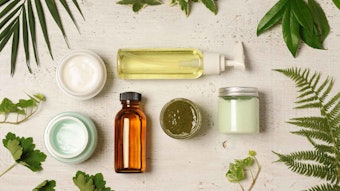
Reduction means fewer components, fewer mixed materials and less unnecessary Waterless and concentrated formats reduce not only water usage but also packaging weight and shipping emissions.WHstudio Leushin N at Adobe Stock
This is where packaging science intersects with human psychology. A refill that leaks, stains or requires force to snap into place will not be adopted, regardless of how sustainable it appears on a slide deck. That is why 2026 packaging trends emphasize mono-material construction and modular refill systems that are intuitive and mechanically sound3.
Aluminum, for example, is seeing renewed attention because it can be recycled repeatedly without degrading performance, and it offers a premium sensory weight that aligns with luxury positioning. Mono-material polypropylene formats are also being explored to simplify sorting and mechanical recycling. These are not aesthetic decisions. They are infrastructure decisions3.
Regulation Is Forcing Precision
Sustainability in beauty is no longer as simple as voluntary branding. It is increasingly compliance-driven. The European Union’s Packaging and Packaging Waste Regulation introduces concrete targets around recyclability and reuse that will impact global supply chains. Extended Producer Responsibility programs in North America are expanding, shifting financial and operational accountability back to brands4.
This means brands can no longer rely on loosely-defined claims. Packaging choices now carry legal, economic and reporting implications. As chemists and product developers, we are being asked earlier in the development cycle to consider end-of-life pathways, recovery rates and material flow. Sustainability is moving upstream.
Formulation Is Part of the Waste Conversation
One of the most under-discussed aspects of zero waste beauty is the formulation strategy itself. Waterless and concentrated formats reduce not only water usage but also packaging weight and shipping emissions. Removing water from a formula can shrink packaging size significantly and reduce overall material throughput5.
Solid cleansers, powdered actives and compressed tablets are gaining traction not because they look sustainable, but because they are materially efficient. They demand higher formulation precision. Texture, solubility and preservation systems must be rethought. Stability profiles change, but when engineered correctly, they can reduce packaging impact without sacrificing efficacy.
At the same time, innovation in paper-based and hybrid materials is expanding secondary packaging possibilities, though barrier performance and humidity sensitivity remain technical constraints that must be solved case by case2.
 Zero waste beauty is not about eliminating packaging entirely, but engineering packaging that respects the full lifecycle of a product.Fitriastudio at Adobe Stock
The Credibility Gap
Consumers are now more literate in sustainability language than ever. In turn, that literacy has exposed a credibility gap. Broad claims like “eco-friendly” or “zero waste” mean little without data to substantiate them. Publications across the industry continue to highlight the need for measurable transparency rather than aspirational language6.
In formulation science, we would never claim an active ingredient works without mechanism, concentration and testing conditions. Sustainability deserves the same rigor. What percentage of post-consumer recycled content is used? What is the refill adoption rate? Where does returned packaging actually go?
Without this level of clarity, sustainability risks becoming another marketing cycle.
Retail and Infrastructure Matter
Even the best-designed packaging cannot succeed in isolation. Recovery infrastructure must exist. Retail take-back programs and collection initiatives are emerging as meaningful bridges between design and disposal, helping capture packaging that curbside systems reject7.
These programs are imperfect, but they represent an important shift. They acknowledge that design alone is insufficient. Circularity is a systems challenge.
Redefining Luxury
The definition of premium beauty is changing. Heavier packaging, double walls and excessive ornamentation once signaled value. Today, sophistication is measured by intelligence: intelligent material selection, intelligent refill systems and intelligent disclosureLuxury now sits at the intersection of performance and responsibility.
Zero waste beauty is not about eliminating packaging entirely. It is about engineering packaging that respects the full lifecycle of a product. It is about aligning chemistry, materials science, consumer behavior and regulation into a coherent system.
For those of us in the lab, that means sustainability is no longer a marketing brief handed down at the end. It is a constraint that shapes the molecule, the emulsion, the pump and the carton from the very beginning.
That is the real evolution happening in beauty. Not softer colors or greener language. Systems. And systems, when designed well, scale.
References
- Cosmetic packaging market size, share: Global report [2034]. Cosmetic Packaging Market Size, Share | Global Report [2034]. (n.d.). https://www.fortunebusinessinsights.com/cosmetic-packaging-market-102130
- Doolan, K. (2026, January 16). 4 beauty packaging trends to know for 2026. CosmeticsDesign. https://www.cosmeticsdesign-europe.com/Article/2026/01/16/4-beauty-packaging-trends-to-know-for-2026/
- Montemayor, C. (2026, February 25). The beauty packaging trends set to define 2026. BeautyMatter. https://beautymatter.com/articles/the-beauty-packaging-trends-set-to-define-2026
- Sustainable cosmetic packaging trends 2026. GreyB. (2026, February 10). https://greyb.com/resources/reports/cosmetic-packaging-trend-report-2026/
- Expert Forecast: 7 High-Impact Trends in Sustainable Cosmetic Packaging for 2026. XILONG PACKAGING CO.,LTD. (n.d.). https://www.xilongglass.com/sustainable-cosmetic-packaging-2026
- Editors, A. (2025, April 22). Allure will never tell you plastic packaging is “recyclable.” https://www.allure.com/story/allure-sustainability-pledge
- Diab, A. (2026, February 24). How refill stores are changing the way we reduce waste. AP News. https://apnews.com/article/climate-refilling-refillable-reusing-recycling-beauty-ca5780c4588ef681a84536b294a4f30e





!['The most polluting industries, pharmaceuticals and cosmetics, will be required to pay at least [80%] of the cost for micropollutant removal...'](https://img.cosmeticsandtoiletries.com/files/base/allured/all/image/2024/01/scientist_water_monitor_sample_pollutionAdobeStock_297782139.65ba74e958d97.png?auto=format%2Ccompress&fit=crop&h=191&q=70&rect=0%2C151%2C2179%2C1227&w=340)