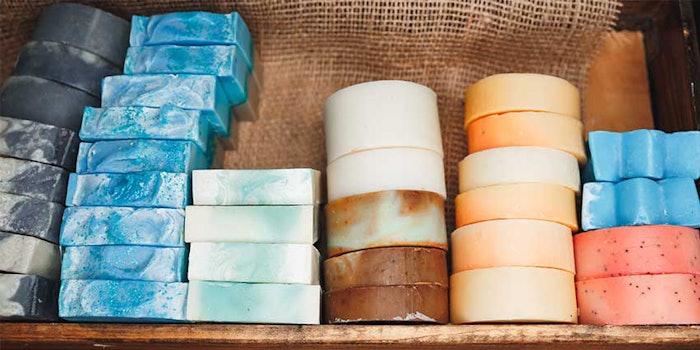
The most commonly used substance for cleaning the skin is soap. It is understood that cleaning the skin with soap removes the skin’s natural moisturizers (such as amino acids, lactic acid, urea and salts), drying the skin. This has a very negative impact on the “skin feel” perceived after washing, and attempts have been made to alleviate these harsh effects of soap by adding mildness additives to soap bars.
Anionic-cationic surfactant complexes are usually too insoluble to be used as surfactants in aqueous solutions. However, these complexes become soluble in excessive detergents. Anionic and cationic surfactants are soluble in aqueous media due to their negative and positive charges respectively. When these surfactants are mixed, the charges are neutralized and consequently the solubility is diminished. This results in the precipitation of the complex.
There have been very few studies on the physical properties of anionic-cationic complexes due to their insolubility in aqueous media. Recently, soluble pseudo-nonionic surfactant complexes were prepared by introducing large additional hydrophilic groups in anionic or cationic surfactants. These charge-neutralized surfactants behave like nonionic surfactants. They exhibit cloud point phenomena unlike their ionic surfactant components and have a low critical micelle concentration. Pseudo-nonionic surfactant complexes are more surface active than their ionic surfactant components as shown by their equilibrium and dynamic surface tension experiments. They pack at the interface more than their ionic component.
The objective of this work was to develop mildness additives by using combinations of cationic and anionic surfactants to form complexes to improve the mildness and skin feel of a soap bar. Equally important, these surfactant complexes were also explored as agents to enhance the physical properties (hardness, slough, use-up and lather) of soap bars.