Surfactant molecules have the ability to self-assemble at concentrations greater than a critic micellar concentration (CMC) into several types of supra molecular aggregates. These aggregates include spheres (micellar phase), cylinders (hexagonal phase) or bilayers (lamellar phases) depending on the amount and types of surfactants that are used. Lamellar phases are not rigid, sheetlike bilayers but rather are elastic and can undulate. Upon shearing, lamellar phases can rearrange into soft colloidal objects of spherical shape consisting of a concentric stack of surfactant bilayers. These objects are called multilamellar vesicles (MLV).
The MLV phase typically exists under shear and thus its structure is considered to be metastable. As a result, orientational phase diagrams frequently are used to describe the structure and phase space. Indeed, MLVs are not in thermodynamic equilibrium. Since they are formed by shear, they inevitably relax into a simple lamellar phase in time. This relaxation can take from hours to several months or years depending on the surfactant system used. Moreover, the stability of MLVs is sensitive to the conditions of process and the purity of the components. Specific mixtures of anionic, amphoteric and nonionic surfactants have proven to be effective for the formation of MLV systems with longtime stability, and numerous rinse-off products based on this technology have been commercialized; for example, sodium-trideceth sulfate and sodium-lauroamphoacetate in combination with lauric acid or alkanolamides have been used.
Considered to be soft solids, MLV systems obey the dynamics of soft glasses. The elasticity and yield stress originates from the close packing of the MLVs. MLV systems are used in body washes and shampoos because they impart the rheology necessary to suspend water-insoluble additives without stringy or tacky extensional properties. Upon dilution, the MLV phase breaks apart, allowing for foaming and efficient deposition.
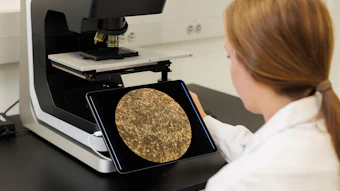
In the present study, the MLV structure in a system under investigation is verified, the bulk rheology and MLV formation are studied, and a method to visualize individual MLVs is presented. The results are related to application-relevant properties such as texture and stabilization of performance additives.