Chosen biweekly for their relevance to personal care, Patent Picks are taken from publicly available sources. This edition features technologies related to skin soothing, moisturizing and repair benefits.
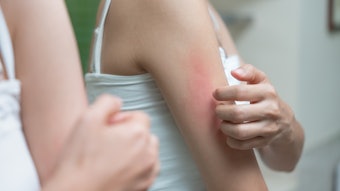
Composition for prevention and/or treatment of pruritus containing Acacia bark derivative
US Patent 8124138
Publication date: Feb. 28, 2012
Assignee: Mimozax Co., Ltd.
The present invention containing an Acacia bark derivative is intended for preventing and/or treating pruritus (itch). Various treatment methods are known for the treatment of pruritus, including topical moisturizers such as Vaseline, urea or heparin; antihistamines such as diphenhydramine or chlorpheniramine maleate; steroids such as dexamethazone or hydrocortisone; antipruritic agents such as crotamiton; and local anesthetics such as dibucaine or lidocaine. With respect to Acacia, acacia honey and tannins extracted from bark thereof can be used as tanning agents. In addition, acacia extracts have been found to have selective inhibitory effects on COX-2, active oxygen eliminating effects, and skin whitening effects due to tyrosinase activity inhibition. However, recently, acacia bark and polyphenols derived from bark thereof have been found to have antipruritic effects. These compositions can be used as a medicine, quasi-drugs or cosmetics, among others.
Plants having an increased content of amino sugars
US Patent 8124842
Publication date: Feb. 28, 2012
Assignee: Bayer Cropscience AG (Monheim Am Rhein, DE)
This patent relates to plant cells and plants having an increased content of N-acetylated glucosamine derivatives, plant cells and plants that synthesize glucosaminoglycans, and their processing. For example, N-acetyl-D-glucos-2-amine (N-acetylglucosamine, GlcNAc) is a glucosamine derivative acetylated at the nitrogen atom. It is a molecular building block of hyaluronan (beta-1,4-[glucuronic acid beta-1,3-GlcNAc]n), which is used frequently in cosmetic products, in particular in skin creams and lotions as a moisturizer, by virtue of its high water-binding capacity.
Silicone acrylate hybride composition for topical delivery
Publication date: Feb. 28, 2012
Assignee: Dow Corning Corporation
The technology described here is a silicone acrylate hybrid composition that includes the reaction product of a silicon-containing pressure sensitive adhesive composition, an ethylenically unsaturated monomer, and an initiator. The composition, which already contains acrylate or methacrylate functionality, chemically integrates the advantageous functionalities associated with both acrylic and silicone chemistries into one stable pressure sensitive adhesive that resists phase separation. In transdermal delivery system applications, the balance of silicone to acrylic can be selectively used to control the solubility of an active agent in the composition to optimize the rate at which the active or other agent is released.
Other agents may include skin penetration or permeation enhancers, accelerants, adjuvants and sorption promoters. These enhancers can be used, for example, to change the ability of the stratum corneum to retain moisture, soften the skin, improve the skin's permeability, act as penetration assistants or hair-follicle openers, or change the state of the skin including the boundary layer. Some of these enhancers have more than one mechanism of action but in essence, they serve to enhance the delivery of the active agent to the substrate.
Striped liquid personal cleansing compositions containing a cleansing phase and a separate benefit phase with improved stability
US Patent 8124573
Publication date: Feb. 28, 2012
Assignee: The Procter & Gamble Company
Disclosed in this patent are personal cleansing compositions that consist of a cleansing phase comprising a surfactant and water, and a separate, substantially anhydrous benefit phase comprising a hydrophobic skin benefit agent. The cleansing and benefit phases have substantially the same density, wherein the cleansing composition is in a form selected from: liquid, semi-liquid, cream, lotion, gel and mixtured forms thereof. Specifically, the striped liquid personal cleansing composition includes: a) a cleansing phase, comprising from about 1% to about 50% w/w of a surfactant; wherein the cleansing phase is non-Newtonian shear thinning, and has a viscosity of equal to or greater than about 3,000 cps and a yield value of at least about 0.1 Pa; and b) a benefit phase comprising from about 20% to about 100% w/w of the benefit phase of a hydrophobic material selected from: lipids, hydrocarbons, fats, oils, hydrophobic plant extracts, fatty acids, essential oils, silicone oils and mixtures thereof.
Polymer particles dispersed in liquid fatty phases for skin care
US Patent 8124112
Publication date: Feb. 28, 2012
Assignee: L'Oreal S.A.
The present disclosure, in one embodiment, relates to a cosmetic composition for caring for or making up the skin and/or epidermal derivatives and/or lips that comprises a physiologically acceptable medium consisting of: a) at least one liquid fatty phase, b) a dispersion of at least one polymer particle in the liquid fatty phase, and c) at least one ester of at least one carboxylic acid comprising 1 to 7 carbons, and at least one polyol comprising at least 4 hydroxyl groups; the ester having a molecular mass of less than 5,000 g/mol. This composition forms a film on the skin, epidermal derivatives or lips that does not undergo transfer, has good staying power and goes on easily. Cosmetic, dermatological, hygienic or pharmaceutical actives that can be used in the composition may be moisturizers, vitamins, essential fatty acids, sphingolipids and sunscreens.
Random ethylene oxide copolymer and non-random alkylene oxide(s) polymer with bioactive agents
US Patent 8124687
Publication date: Feb. 28, 2012
Assignee: Syncera, Inc.
Described herein is a polymeric material, preferably a polymer alloy, consisting of: at least one random copolymer comprised of ethylene oxide and one or more other alkylene oxide(s), an at least one non-random polymer comprised of one or more poly(alkylene oxide)s. Alkylene oxide homopolymers or block copolymers may be the non-random polymer. In a related discovery, an adhesive material can be made by suspending particles in a matrix of at least one poly(ethylene oxide) copolymer of ethylene oxide and propylene oxide, or a combination thereof, of which the handling characteristics may be adjusted for different utilities, e.g., from runny oil to hard wax. Applications include use as adhesive, cohesive, filler, lubricant, surfactant or any combination thereof.
In particular, the hard materials may be used for cleaning or waxing. The compositions are also suitable as a matrix for particulate material, adhesive/cohesive, filler and/or lubricant; they may also be used as dispersing or suspending agents, emulsifiers, extenders, thickeners and/or bodying agents for compositions, in particular for cosmetic and pharmaceutical formulations. For example, the formulation can be used as a cleanser bar that can be further enhanced by including other cleansing agents, boosters, colorants, fragrances and moisturizers in the formulation.
Personal care compositions of sulfonated estolides and other derivatives of fatty acids and uses thereof
US Patent 8124577
Publication date: Feb. 28, 2012
Assignee: Stepan Co.
Formulations of personal care compositions and personal care concentrate compositions containing sulfo-estolides are described by these inventors. Personal care compositions of the present technology include liquid hand soaps, bath and shower washes, shampoos, 2-in-1 or 3-in-1 shampoos, antidandruff shampoo, facial cleaners, among others. The present technology, in general, relates to sulfo-estolides. More particularly, the present technology relates to sulfo-estolides derivatives and salts of sulfo-estolides and the various applications and/or processes of utilizing them in personal care compositions. It has been surprisingly and unexpectedly found that addition of sulfo-estolides to personal cleansing compositions provide enhanced foaming properties in addition to the ability to change the viscosity of the personal care products to desired ranges without the loss of other valuable properties, including cleaning ability/cleansing, softness, moisturizing ability/moisturization, enhanced mildness, good rinsing, and/or improved skin/hair feel.
Porous keratin construct for skin repair
US Patent 8124735
Publication date: Feb. 28, 2012
Assignee: Keraplast Technologies, Ltd.
This invention relates to a porous keratin material comprising keratin protein for use in wound healing applications. According to the patent, the porous keratin is capable of bio-absorbing into a wound to promote wound healing and the rate at which it absorbs into the wound may be controlled by altering the degree of disulfide cross-linking between the keratin proteins. Keratin has been shown to be a valuable component in wound healing materials but to date, no prior art has disclosed a satisfactory manner for effectively introducing keratin into a wound site while still achieving desirable characteristics associated with a wound healing material. With a controlled rate of absorption, the invention can ensure that keratin remains in the wound for a period of time adequate to aid in the healing of the wound and reducing or eliminating the need to remove the material from the wound, greatly reducing the chance of re-traumatizing the wound site when a new material needs to be applied.