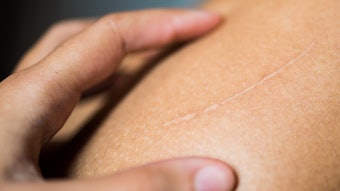
Many consumers have scars, sunspots or other unwanted dark spots that seem to have appeared overnight. These are all caused by hyperpigmentation, i.e., an increase in melanin production as a direct result of damage. Whether it is an old scar on the knee, or freckles scattered across the shoulders from an afternoon at the beach, both are caused by alterations in melanogenesis.
Melanin is the inherent compound responsible for pigmentation and it is found in the hair, skin and eyes. It plays an important role in protecting skin from the harmful effects of UV radiation and in scavenging toxic drugs and chemicals. Biological agents interfere with pigmentation through different mechanisms—ranging from interaction during the initial stages of melanogenesis, to the destruction of the melanocyte—and this article will focus on the key ones: tyrosinase inhibition, maturation and degradation; MITF inhibition; downregulation of MC1R; interference with melanosome transfer; and desquamation and peeling.