NEW YORK—The SCC Annual Meeting, held Dec. 6 and 7, 2012, in Manhattan, went off without a hitch thanks to the efforts of SCC Executive Director Bill Cowen, among others, who moved and re-established the SCC headquarters after hurricane Sandy blasted the East Coast in late October. As of mid-December, the national office was still operating at less than 100%, although many attendees of the event reported feeling lucky they had experienced minimal effects from the storm.
Scientific Session Day I
Microflora: The event featured topics ranging from cosmetic dermatology and regulations in China, to formulations, sunscreens, and hair and scalp treatments. The first session on cosmetic dermatology, moderated by Martha Tate, PhD (Kimberly-Clark) explored various health and anti-aging aspects of skin care. Elizabeth Grice, PhD, of the University of Pennsylvania, opened the session with a survey of the microbiome of normal skin and its variations based on individuals’ cutaneous immune system and greater microbial community conditions. Grice noted that analyses of microbial communities can be useful to outline problematic microbe colonization and infection.
Repair/Anti-aging: Cristina Carreño, PhD (Lipotec) used a combinatorial chemistry approach to indentify hexapeptides that can stimulate DNA repair pathways. The efficacy of these peptides was validated by measuring their ability to restore function in previously damaged reporter genes. David Boudier (Silab) also focused on repair, specifically the decreased capacity of aged keratinocytes to synthesize the vitamin D receptor. He proposed a treatment based on chicory root extract, which was shown to induce a vitamin D-like effect, to restore homeostasis in skin.
Optics, lasers and more: Rox Anderson, MD, of Harvard Medical School, rounded out the morning session with the Frontiers of Science Award Lecture on the physics of looking better. Sponsored by Cosmetics & Toiletries, his presentation looked at physical factors affecting appearance, such as diffuse spectral reflectance, color texture and translucency, and considered how these attributes might be manipulated for desired effects. His thoughts led into futuristic concepts, such as fiber optics to impart transparency in color cosmetics.
Anderson also described dermatological conditions and fractional lasers developed in his labs to treat them, including those to physically damage skin, in turn inciting micro-repair. “You can get away with murder as long as it’s on a micro-scale,” he said. He emphasized the need for the personal care industry to focus on elastic recoil in relation to aging, presenting an astounding case of a 28-year-old with a rare condition causing the nearly total loss of elastic recoil in her skin. Attendees guessed her age to be in the 60+ range, and gasped in unison when they learned she was just 28. Finally, he briefly touched on radio frequency, ultrasound and cold as novel treatments to reduce cellulite; blue light to treat acne; and low level light therapy (LLLT), which affects gene expression. He conceded, “I used to think there’s no way LLLT could work but this is a very real and very exciting area.”
Anderson ended with a few key points: “This is a call to arms. We are all in the business of helping to make people look better. There is no real line between cosmetic and medical, and synergies can come from combining things that work very differently; like cosmetics and devices.” For more on this presentation, see the December issue of Cosmetics & Toiletries.
Awards Luncheon
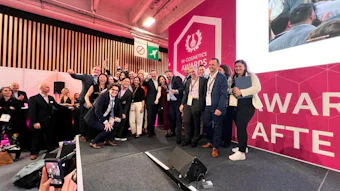
The Theresa Cesario Awards Luncheon once again honored the innovation and dedication of several key individuals to the industry. Karl Lintner, PhD (KAL’Idées) received the prestigious Maison G. DeNavarre Medal Award for his distinguished career as a scientist, significant contributions to the society, numerous presentations across the globe, and status among his peers. “For once, I am speechless,” said Lintner, humbled, after receiving the award. He thanked the industry and society, and especially his wife for her support.
The Shaw Mudge Award, sponsored by BASF Corp., was presented to Jürgen Meyer, PhD (Evonik) and co-authors for their paper examining lamellar phases in emulsions. Bob Lochhead, PhD (University of Southern Mississippi) and co-authors were given the Allan B. Black Award, sponsored by Presperse Corp., for their paper on a cosmetic technology to protect wearers from thermal blast. The Hans A. Schaeffer Award, sponsored by Lonza Personal Care, was given to Jeffrey Seidling (Kimberly-Clark) and co-authors for their paper on incorporating phase-change materials into facial tissues. This work was also previously honored as a finalist in the Cosmetics & Toiletries 2012 R&D Awards.
Sponsored by Croda Inc., the Joseph P. Ciaudelli Award went to Roger McMullen, PhD (Ashland Inc.) and Janusz Jachowicz, PhD (Better Cosmetics LLC), for their paper examining tryptophan fluorescence in hair. The Des Goddard Award, also sponsored by Lonza, was presented to John Chiefari, PhD (Commonwealth Scientific and Industrial Research Organization) for his work on RAFT Technology as a way to develop polymers for cosmetic formulations.
The Society of Cosmetic Chemists Award, sponsored by The Hallstar Company, went to Gary Agisim (Pfizer) and co-authors for their work on improving the taste of sunscreen filters in lip balm. Lastly, the Frontiers of Science award, sponsored by Cosmetics & Toiletries, was presented to Rox Anderson, MD (Harvard Medical School). “With our mission to present cutting edge science that advances technologies for successful product outcomes, this presentation fits the profile of Cosmetics & Toiletries very well,” said Rachel Grabenhofer, editor.
China Regulations
The afternoon session transported attendees into China’s regulatory landscape, where Mike Fevola, PhD (Johnson & Johnson) led the charge as session moderator. Kenneth Marenus, PhD (Estée Lauder), started with the basics, explaining that regulations for imported cosmetic products involve the State Food and Drug Administration (SFDA) within the Ministry of Health and the general Administration of Quality Supervision, Inspection and Quarantine (AQSIQ) government agencies. The responsibility for product safety is on the government, and while the market in China is relatively young, it is growing rapidly, which puts heavy responsibility on an already burdened system.
Considering these aspects along with the recast of European Union (EU) directive, and the impact on research and development becomes profound. “The idea of global accepted formulations is slowly eroding to the point where constant reformulation may become the order of the day,” wrote Marenus. “The similarities in the EU and China approaches to regulation are striking in terms of data requirements…The industry needs to come to terms with this emergent regulatory reality in order to provide counterbalance.”
Additional presentations on regulations in China included Victor Mencarelli’s (BASF), which looked at the opportunities and impediments in this market; Yun Shao’s, PhD (Kobo Products Inc.), with an overview of cosmetic ingredient regulations; and Francine Lamoriello’s (Personal Care Products Council), describing “China today,” including socio-economic factors of this important market. Attendees of this session noted it was a topic of great interest, although to some, it created more questions. One attendee noted, “it seemed to be a case of, ‘yes, but…’ or ‘no, but…’ for many of the questions attendees asked during the Q&A session.
The session wrapped up and many attendees retired to the evening Supplier’s Cocktail Reception for networking and music, and to catch up with old friends.
Scientific Session: Day II
Sunscreens: Formulating and sunscreen topics kicked off the second day’s session, moderated by Akshay Talati (Estée Lauder Companies). Pascal Delrieu, PhD (Kobo Products) presented the keynote lecture on developing non-nano composite UV powders for safe and effective sunscreens. Due to concerns over the penetration of nanomaterials, several companies have developed technologies with “non-nano” labels. Delrieu described an ultrafine TiO2 fully dispersed and entrapped within an acrylate copolymer matrix, resulting in a powder having a mean particle size of 3-9 microns, with none smaller than 100 nm. The technology showed SPF results as effective as dispersions of the ultrafine TiO2 and better than standard TiO2 powder. Skin feel and transparency effects also were presented. This presentation gained attendees’ interest, as it was a topic of conversation throughout the day.
Paul Staniland, PhD (Croda Europe) used electron spin resonance spectroscopy to measure UV- and high energy visible (HEV) light-initiated radical generation in skin substitutes. His work indicated that both UVA and UVB light cause free radicals, and that an enhanced UVA-TiO2 remarkably reduced the number of free radicals in skin due to its scattering effects in the HEV region. Li Zhang, PhD (The Dow Chemical Company) examined water resistance in sunscreen emulsions to determine why sunscreen films lose water resistance properties over time. Results indicated that preventing the re-emulsification of the film kept it in place longer, and that desired sensory benefits can be maintained with water resistance properties.
Formulating: J. Chris Dederen, PhD (Croda Europe) then discussed sensory mapping to detect the perceivable effects of emulsifiers in emulsions, showing how to recognize various types of emulsions in a score plot and to find and control emulsions for specific sensory effects. Michael J. Fevola, PhD (Johnson & Johnson) presented on polymerized surfactants for mild cleansing—specifically, how a deeper understanding of micelle size distributions can further exploit the concept of hydrodynamic size exclusion as a mechanism for preventing surfactant penetration and irritation. This approach has led to vast improvements in product mildness.
Luncheon and 2013 Board Installation
During the second day’s luncheon, Joseph Pavlichko received the SCC Merit Award for his service and leadership to the society, and Joseph Dallal was presented the SCC’s Certificate of Appreciation for serving as 66th president and for furthering the progress of the society. Lastly, the society’s 2013 Board of Directors was installed, including: Guy Padulo (Kobo Products, Inc.) as president; Dawn Burke-Colvin (Mary Kay, Inc.) as vice president; Tony O'Lenick (Siltech, LLC) as vice president-elect; Peter Tsolis (Estée Lauder Companies) as treasurer; Dawn Thiel Glaser (Beraca) as secretary; Joseph Albanese (3V, Inc.) as director of Area I; Joy Welsh (Commonwealth Soap & Toiletries) as director of Area I; Kelly Dobos (Kao Brands Company) as director of Area II; Perry Romanowski (Brains Publishing) as director of Area II; Marc Ward (Wasatch Product Development) as director of Area III; Lisa Jones (Coast Southwest) as director of Area III; John Wagner (Merck Consumer Care) as director of Area IV; and Michelle Linscott (Xytrus) as director of Area IV.
Hair Condition and Growth
Hair condition: The final session of the meeting featured hair and scalp treatment topics, with dedicated speakers and attendees who "stuck it out" until the end. Howard Epstein, PhD (EMD Chemicals) moderated the session. First up was Timothy Gao, PhD (Croda Inc.), who discussed atomic force microscopy (AFM) to study hair surface morphology and how it affects hair shine and color vibrancy. He utilized the company’s hair color vibrance factor (HCVF) parameter to describe these attributes. His work showed that nano-scale determinations of hair smoothness were a good indication of hair shine, higher HCVF factors and matched objective evalutions.
Mike Hindley (Croda Europe) described a video imaging technique coupled with special software to quantify and analyze hair movement. Being most affected by damage and reparative treatments, the swing of hair tresses was assessed via this method, which could show improved swing with improved condition. Kazim R. Naqvi (University of York) presented the catalytic activity of transition metal ions in generating hydroxyl free radicals in hair coloring systems. The colorimetric probe N,N’-(5-nitro-1,3-phenylene)bisglutaramide (NPGA) showed that ethylenediamine-N,N'-disuccinic acid (EDDS) had a strong preference for copper ions and was effective in suppressing radical chemistry under realistic hair coloring conditions. EDDS was therefore suggested as a tool for controlling the formation of radical species in a coloring system to reduce damage to the hair fiber.
Hair growth: Finally, Thomas Mammone, PhD (Estée Lauder Companies) showed how increasing cellular energy via Adenosine diphosphate (ADP) promotes hair growth. ADP was found to increase DNA synthesis in papilla cells up to 20-fold at 0.5 mM while it increased DNA synthesis up to 14-fold at 0.25 mM. Hair plugs and eyelashes treated with this energy blend showed increases in hair length after 16 weeks of treatment.
According to SCC event organizers, the event was light in attendance from previous years—although it was not light in content. In fact, this editor heard at least three excited attendees comment on the different tracks they attended. One, reacting to the Frontiers of Science award lecture, said, “This is exactly what’s been missing.” Another greatly appreciated the China regulatory track, as it seems many manufacturers struggle with the rules for this market. A third really enjoyed the discussion of non-nano composites for sunscreen regulations, stating, “some very interesting concepts were presented in that talk and in that session.” If you attended, whether you agree or disagree, or experienced moments of brillance in other sessions, it’s safe to say the information presented merely hints at the step-changes to come.