Last month’s “Ingredient Profile” column reviewed polyquaternium-6 (PQ-6), the cationic homopolymer of diallyldimethylammonium chloride (DADMAC). In relation, this month’s column examines its cousin, polyquaternium-7 (PQ-7), one of the most widely used and cost-effective conditioning polymers for personal care applications.
Chemistry and Manufacture
PQ-7 is the polymeric quaternary ammonium salt derived from the copolymerization of acrylamide (AM) and DADMAC monomers.1 The level of cationic DADMAC monomer incorporated into PQ-7 type copolymers may vary quite dramatically, from 5–80 mol%.2 Personal care grades of PQ-7 are reported to contain from 25–50 mol% DADMAC and a balance of 50–75 mol% AM, and may exhibit molecular weight (MW) values ranging from 1.0 × 10⁵ g/mol to 3.0 × 10⁶ g/mol.3–5 Like PQ-6, PQ-7 is also a strong polyelectrolyte, yet its charge density is significantly lower than that of PQ-6 due to the incorporation of nonionic, hydrophilic AM repeat units in the polymer chain (see Figure 1).
AM monomer: AM monomer is a small volume commodity chemical that can be traced back to propylene, a petrochemical feedstock derived from natural gas. Figure 2 shows the commercial synthesis route for producing AM, which involves the ammoxidation of propylene to produce acrylonitrile, followed by the catalytic hydration of the acrylonitrile to AM. In the first reaction, propylene gas is reacted with oxygen and ammonia over a solid bismuth-molybdate catalyst to generate acrylonitrile, itself a useful monomer and chemical intermediate. The acrylonitrile is then heated with water over a copper catalyst to yield the AM monomer, which may be supplied as a white crystalline solid or a 50% aqueous solution stabilized with 25–50 ppm Cu2+ ion to prevent autopolymerization during storage and shipping.6
Monomer reactivity ratios: No discussion of PQ-7 synthesis is complete without mentioning the concept of monomer reactivity ratios. When two ethylenically unsaturated monomers, M1 and M2, are reacted together via free radical addition copolymerization, the composition of the resulting copolymer will be governed by the reactivity of each monomer with the propagating radical chain end (see Figure 3), which in turn depends upon the ultimate repeat unit of the growing chain—i.e., whether there is an M1 or M2 radical species on the chain end.7 The reactivity ratios, r1 and r2, are defined as:
r1 = k11/k12 and r2= k22/k21
and indicate the ratio of the rate constant for a reactive propagating species adding its own type of monomer (k11 or k22) to the rate constant of its addition to the other monomer (k12 or k21). In the ideal case, r1 = r2 ≈ 1, meaning that both monomers M1 and M2 will react at similar rates regardless of whether there is an M1 or M2 on the growing chain end, and the resulting copolymer will contain a random distribution of the two monomers.
However, if M1 reacts preferentially over M2 (i.e., r1 > 1 and r2 < 1), more M1 will be consumed earlier in the reaction. Thus, copolymer chains formed early in the reaction will be rich in M1 and those formed later in the reaction will be rich in M2, a phenomenon known as compositional drift. When compositional drift occurs, the resulting copolymer product will be a heterogeneous mixture of individual copolymer chains of varying comonomer composition; such heterogeneity will influence the properties and performance of the copolymer product.
AM-DADMAC copolymerization: For the copolymerization of AM (M1) and DADMAC (M2), the reactivity ratios differ by up to two orders of magnitude, with reported values of r1 = 4.8–7.1 and r2 = 0.03–0.22.8 Thus, if AM and DADMAC are simply mixed and reacted together in a batch copolymerization, significant compositional drift will occur, resulting in a PQ-7 product with a heterogeneous distribution of AM and DADMAC in the copolymer chains. To obtain PQ-7 with a more uniform comonomer distribution, semi-batch copolymerization processes must be employed, wherein the more reactive AM monomer is slowly fed into the copolymerization reaction to ensure uniform consumption of both monomers and a more homogeneous comonomer distribution in the final product (see Figure 4).9, 10
PQ-7 for personal care applications is usually produced via the aqueous solution copolymerization of AM and DADMAC in a semi-batch process like that shown in Figure 4, where AM monomer and initiator are fed continuously into a reactor initially charged with water, DADMAC, a portion of AM, a portion of initiator, and other additives—e.g., chelating agents, pH adjusters, etc. This reaction is conducted in an oxygen-free environment, either under vacuum or nitrogen blanket, at temperatures of 30–60°C and is initiated using common radical initiators such as persulfate salts or water-soluble azo compounds.
A critical step in the process is the monomer-scavenging treatment that occurs following the polymerization. In this step, the PQ-7 solution is treated with excess initiator or other compounds at higher temperatures (70–80°C) to eliminate any unreacted monomer in the product. While the (co)polymers are essentially nontoxic, the unreacted AM monomer is a neurotoxin,3 and only PQ-7 materials with residual levels of less than 10 ppm AM have been indicated as safe by the Cosmetic Ingredient Review expert panel.11 In practice, many suppliers of personal care grade PQ-7 strive to maintain residual AM levels of < 1 ppm to ensure it is virtually undetectable in finished goods.
Properties
The PQ-7 used in personal care applications is typically supplied as a clear, colorless aqueous solution with values of pH = 6.0–7.5 and pH = 3.3–4.5 for paraben-preserved and sodium benzoate-preserved solutions, respectively. Due to the high MW of most PQ-7 type polymers, the solutions exhibit viscosities of ca. 7,000–15,000 cP, yet they contain only 8–10% w/w active polymer solids.3, 5, 12–13
Grades of PQ-7 with lower values of MW and charge density are available and contain up to 40% w/w solids with solution viscosities of 1,200–4,000 cP.3–5 Potential impurities in solutions of PQ-7 may include residuals such as trace (ppm) levels of AM, up to 1.5% w/w DADMAC monomer, polymerization initiators and decomposition products of polymerization initiators, in addition to additives used during the polymerization process—e.g., chelating agents, pH buffers, etc.
Applications
PQ-7 type copolymers are broadly deployed in a variety of industrial applications, including water treatment, mineral processing and paper manufacturing.2 In cosmetics and personal care formulations, PQ-7 functions as an antistatic agent, a film-former and a hair fixative,1 although it is more generally recognized as a conditioning agent for hair and skin. PQ-7 has been shown to be highly substantive to keratinous substrates,14, 15 and it is a favorite as an inexpensive yet highly effective conditioning agent in rinse-off formulations such as shampoos, rinse-out hair conditioners, body washes, liquid hand soaps and bar soaps.
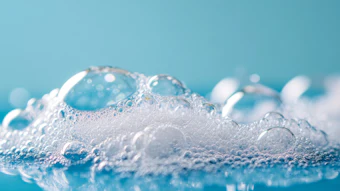
PQ-7 can also be used to modify the lathering properties of surfactant-based cleansers and shaving creams since it decreases foam bubble size, increases foam stability and provides slip, leading to richer, creamier, more lubricious foams. Its use in leave-on formulations also has been reported for applications including hair styling and skin moisturization.
PQ-7 is typically employed at 0.1–0.5% w/w active polymer solids in most formulations. In terms of formulation compatibility, PQ-7 is more forgiving than PQ-6 due to its lower charge density and it is readily combined with solutions of anionic surfactants and polymers to provide clear formulations. Solutions of PQ-7 are generally mixed into formulations near the end of the batch process and do not require heating or other special processing conditions. Reproduction of the article without expressed consent is strictly prohibited.
References
Send email to [email protected].
1. Polyquaternium-7, Monograph ID 2443, in the International Cosmetic Ingredient Dictionary and Handbook, 13th edn, Personal Care Products Council: Washington, DC, USA (2010)
2. S-Y Huang, DW Lipp and RS Farinato, Acrylamide polymers, in Kirk-Othmer Encyclopedia of Chemical Technology, vol 1, published online, John Wiley and Sons, Hoboken, NJ, USA (Aug 17, 2001) pp 304–342
3. Merquat polyquaternium-7 series, Nalco product bulletin PC-PolyQ-7, Nalco Co., Naperville, IL, USA (2007)
4. Optasense CP7 conditioning agent, Croda product bulletin DS-206R-3, Croda Inc., Edison, NJ, USA (Dec 2009)
5. Salcare conditioning polymers, Ciba HP&C technical presentation, available at www.markell.ru/files/file5556.PPT (Accessed Feb 14, 2011)
6. CE Habermann, Acrylamide, in Kirk-Othmer Encyclopedia of Chemical Technology, vol 1, published online, John Wiley and Sons, Hoboken, NJ, USA (Aug 16, 2002) pp 288–304
7. GG Odian, Principles of Polymerization, 4th edn, ch 2, John Wiley and Sons, Hoboken, NJ (2004) pp 464-543
8. C Wandrey, J Hermindez-Barajas and D Hunkeler, Diallyldimethylammonium chloride and its polymers, Adv Polym Sci 145 123–182 (1999)
9. F Brand, H Dautzenberg, W Jaeger and M Hahn, Polyelectrolytes with various charge densities: Synthesis and characterization of diallyldimethylammonium chloride-acrylamide copolymers, Angew Makromol Chem 248 4286 41–71 (1997)
10. US Patent 5110883, Process for the production of high molecular weight copolymers of diallylammonium monomers and acrylamide monomers in solution, HA Gartner, assigned to Dow Chemical Co. (May 5, 1992)
11. FA Andersen, Final report on the safety assessment of Polyquaternium-7, J Am Coll Toxicol 14 6 476–484 (1995)
12. Mirapol 550, Rhodia product data sheet N000171, Rhodia Novecare, Cranbury, NJ, USA (Sep 2008)
13. Mackernium 007S, Rhodia product data sheet 182010400, Rhodia Novecare, Cranbury, NJ, USA (Jan 2010)
14. J Jachowicz, S Maxey and C Williams, Sorption/desorption of ions by dynamic electrokinetic and permeability analysis of fiber plugs, Langmuir 9 11 3085–3092 (1993)
15. B Blanco, BA Durost and RR Myers, Gel permeation chromatography: An effective method of quantifying the adsorption of cationic polymers by bleached hair, J Soc Cosmet Chem 48 127-131 (May/Jun 1997)