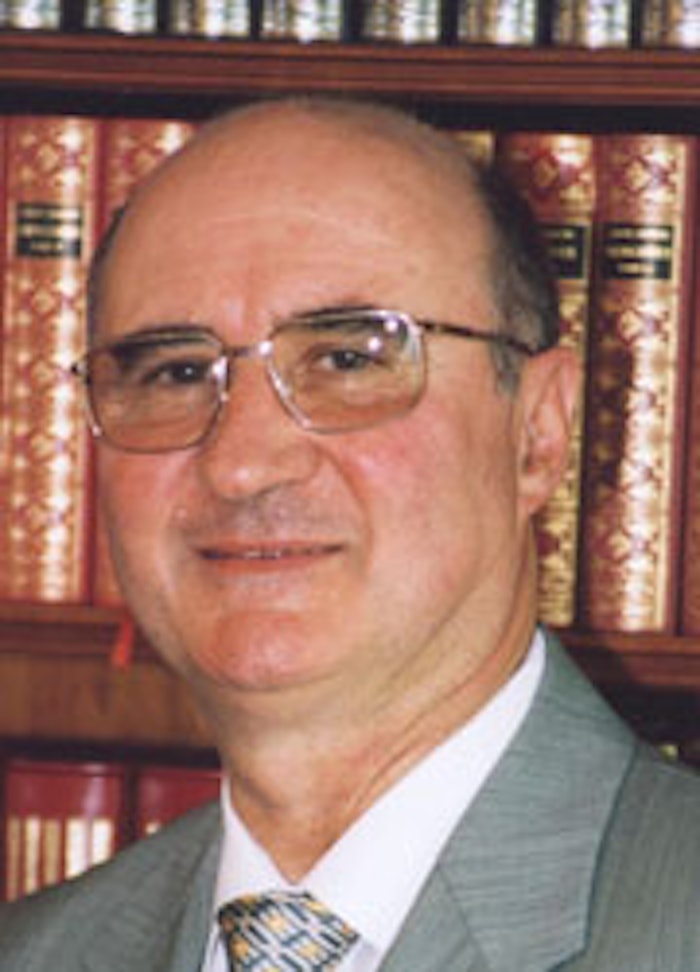
There are a few vital sensory experiences that lead to a product purchase, and while the visual and tactile experiences are the responsibility of the product formulator, of equal importance is olfaction. Some might consider olfaction solely the job of perfumers, but Jean-Jaques Étienne, PhD, believes it to be the job of perfumers as well as formulators. Étienne has been in the cosmetics industry for more than three decades with Orlane and Parfums Rochas, and in addition to his experience in production, quality control, formulation and raw material development, he also has uniquely been involved with the perfumery industry. Étienne maintains that a formulator should have “one foot on the perfumery side and one foot on the cosmetics side,” and the following interview highlights some of the experiences that have led him to this conclusion.
C&T: Coming from a research background, what was your first impression of the cosmetics industry?
The cosmetic field was [viewed as] something adventurous and lacking seriousness. My boss, who managed my thesis, was a little disappointed that I left the research field for a field that was not as serious, but what I wanted was the opportunity to stimulate my mind, and cosmetics allowed me to do this.
C&T: What is one of the biggest lessons you have learned over the years?
In our field, there are a lot of raw materials that have complicated names and compositions. One formula we developed contained the carbomer Carbopol 940 but when this emulsion was prepared, instead of keeping its consistency, it became thick in the bottles. After asking a lot of questions, we learned the technician was short on Carbopol 940, so he used 941. In the beginning, the product was the same but over time its viscosity changed. I give this example to students to [emphasize] always providing the exact materials being used because this can be the source of many problems.
C&T: What advice would you give to someone just starting out in the industry?
Cosmetic products must have a beautiful story but a simple explanation, even if their ingredients have complicated mechanisms of action. Complicated active ingredients are often difficult to explain to consumers. Formulators should make products that are relatively simple, conceptually, and easy to understand their claims and purposes. A simpler system is easier to handle, test and regulate. Avoiding complicated formulas and limiting the number of ingredients can give the formulator a clearer view, so they can easily modify or substitute something. A film technology with which formulators could manage substances that penetrate the skin would greatly benefit cosmetics.
C&T: What has been one of your greatest cosmetic accomplishments?
Nearly 15 years ago, we had the idea to create a blush with the nice after-feel provided by silicone oils and silicone waxes. It was difficult at [that time] because there were no surfactants to made this possible. The water-in-silicone blush that we created was quite original.
C&T: What do you find most difficult about product development?
Creating complementary products to a fragrance line can be difficult because they must smell the same. A fragrance composition in alcohol produces something beautiful but the same fragrance in a [product] like a shampoo can disappear completely. [In addition, there are] scents associated with cosmetic ingredients; in bath oils and gels, lauryl ether sulfate has a specific smell that is difficult to cover. [Further], a fragrance compound might be soluble in alcohol but is insoluble in the water phase of an emulsion. Quantities can also affect the way different products smell; in the alcohol, the fragrance compound can be 12–13% but in the cosmetic products it is difficult to go over 3–4%. Of course, these products must also stay within a specific cost range.
C&T: How can the formulator overcome these challenges?
The formulator should create complimentary cosmetic products that are as discreet as possible with no specific smell. Then they should look closely at the behavior of the fragrance with the perfumer. For example, vanilla is widely accepted so perfumers use it frequently, but vanilla browns emulsions.
C&T: How can a formulator work better with a perfumer?
[Since] cosmetic ingredients introduce their own specific smell, the formulator should always choose ingredients that do not smell or smell the least. The cosmetic side often says that masking the odor is the perfumer’s responsibility but this a foolish position. Perfumers are not always able to cover such fragrances and sometimes they succeed in the beginning, only for the odor to reappear with time. Even an odor viewed as acceptable on the cosmetic side is a problem for a perfumer.
C&T: What technology has revolutionized the cosmetic industry?
In my time in cosmetics, I have seen the concept of skin hydration become recognized due to the invention of the rheometer. The idea was to measure the resistance of skin to show that a hydrating cream increases its conductivity. A change in the resistance of the skin showed that the water level in the skin was improved. This may have been the first example of instrumentation in cosmetics being developed to demonstrate a claim. Many instruments have since been developed to demonstrate the effectiveness of cosmetic claims. Another example is confocal microscopy, which [makes it possible] to look inside the skin to explain the actions that occur there. These instruments helped communicate the mechanisms of action behind cosmetics, which can be difficult.
C&T: What do you see in the future for cosmetics?
In 2003, I had the initial idea of a process now under development that inhibits the penetration of fragrance allergens. In fragrance, there are a lot of regulations on allergens but if we were able to inhibit the penetration of such substances with a film, these allergens, such as aldehydes, would not be a problem. [Therefore, a film is currently being developed] that is soluble in alcohol and does not smell bad but the details are still confidential. This technology would greatly benefit cosmetics [in that formulators could manage which] substances stay on the skin and which ones penetrate. The film would act like a net, retaining undesirable substances such as parabens but allowing actives to penetrate and act on the keratinocytes. Parabens are there to preserve [creams and other products in their packages to avoid microbial growth], not to penetrate the skin for cosmetic activity. This would eliminate many problems in the cosmetics industry.