Log In
Register
Facebook icon
LinkedIn icon
Instagram icon
Testing
Animal Alternatives
Efficacy
Method/Process
Microbiology
Saftey/Stability
Sensory
Sun Protection
Tech/Equipment/Services
Method/Process
Companies
EcoBeautyScore Consortium Calls for Public Review of Methods, Scoring System by May 9
The EcoBeautyScore (EBS) Consortium is seeking public comments through May 9, 2024, to finalize its methods and scoring system that will provide beauty consumers with clear, transparent and comparable environmental impact information about products.
Method/Process
Skinobs' V2.0 Simplifies and Accelerates Preclinical and Clinical Beauty Testing
Method/Process
The DNA & Cosmetics Consortium Developing Database for Beauty Ingredient Traceability
Latest
Event Coverage
Which Cosmetic Product Test Method/Tool, Device and Digital Tech Will Clinch
C&T Allēs
in 2024?
Which test method/tool, device and digital technologies will win
C&T Allē Awards
? Find out at our exclusive dinner on March 6, 2024, at the Biltmore, L.A. – alongside our captivating
Beauty Accelerate
event. Following are the contenders...
Method/Process
'Testing Tactics in Hair' Column Series — An Index of Works by Trefor Evans, Ph.D.
From 2013-202, adviser and columnist Trefor Evans, Ph.D., wrote the column series, "Testing Tactics in Hair" for
Cosmetics & Toiletries
, covering methods to measure damage, treatments, claims and more. This is an index of his works.
Sponsored
100% Green Cationic Conditioning Active and Afro Hair Care
Kerashaft Alab: 100% green biotech cationic active outperforming synthetic quats, tested on Caucasian and Afro hair. Proven combing improvement detangling, breakage reduction, anti-frizz, gloss and styling action.
Event Coverage
2 Winners and 4 Finalists Shine in 2023 Cosmetic Victories Competition
Cosmetic Victories finalists included a human skin model, natural senolytic ingredient, photoactivable algae derivative for anti-acne effects, a palm oil alternative and both in vitro sunscreen ecotoxicity and contaminant testing. See who won.
Audio
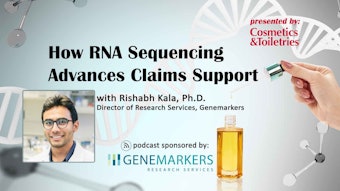
[podcast] How RNA Sequencing Advances Claims Support
RNA sequencing is a newer, more dynamic approach than DNA sequencing to measure the effects of ingredients and products on skin. Rishabh Kala, Ph.D., of Genemarkers, explains its capabilities in this sponsored podcast. Listen now; it's free.
Literature/Data
Kao's New Infant Sebum Testing Protocol Can Flag Atopic Dermatitis, Parkinson's Disease
The move is the start of Kao's expansion into health testing services.
Method/Process
Environmental Stress Panel for Evaluating Diesel Particulate Matter==> download our unique Gene Expression Panels Guide at no cost
Genemarkers, a trusted partner for applying genomic technologies to personal care product development, has launched a new testing service to evaluate how product formulations protect or repair skin in response to diesel particulate matter (DPM).
Safety
FDA, Unilever and GSK Challenge Valisure's Benzene Findings, Test Methods
The FDA recently raised concerns over the test methods of Valisure, the Connecticut-based lab whose reports over benzene in sunscreen and dry shampoo products from Unilever, GSK and others have prompted recalls and class action suits.
Literature/Data
[updated] How to Ensure Cleansers Comply with Growing 1,4-Dioxane Regulations
A review in the
Journal of Surfactants and Detergents
explored means of measuring 1,4-dioxane levels in cleansers in order to comply with increasing ppm restrictions set by U.S. states. In this update, industry expert Tony O'Lenick adds context.
Method/Process
DNA Metabarcoding Tracks Traceability of Naturals: Wild Teasel Case Study
This study authenticates
D. fullonum
from raw material to final ingredient. It compares
D. fullonum
and
D. sylvestris
in a three-step study by: barcoding the raw material, metabarcoding the two extracts and bioinformatics processing.
Tech/Equipment/Services
Next-generation Sequencing for Personal Care Product Development
Introducing Genemarkers’ NextGen sequencing, a cost-effective method for analyzing differentially expressed genes to detect novel biomarkers. This method can help discover new pathways and biological mechanisms of action for ingredients and formulations.