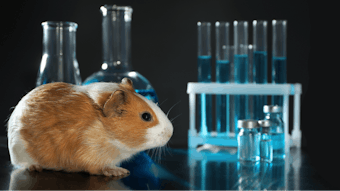
The National Institute of Health (NIH) is collaborating with the Enviromental Protection Agency (EPA) to improve the safety testing of chemicals. Both agencies have agreed to a new toxicity testing agreement to reduce reliance on animal testing.
The concept behind this agreement is highlighted in the Feb. 15, 2008 issue of the journal Science. According to the report, the collaboration has the potential to make crucial discoveries that will protect the public health by identifying and understanding chemical toxicants to which people are exposed.
Two NIH institutes have formed a collaboration with the EPA to use the NIH Chemical Genomics Center's (NCGC) high-speed, automated screening robots to test suspected toxic compounds using cells and isolated molecular targets instead of laboratory animals. The trans-agency collaboration is anticipated to generate data more relevant to humans; expand the number of chemicals that are tested; and reduce the time, money and number of animals involved in testing.
Full implementation of the hoped-for paradigm shift in toxicity testing will require validation of the new approaches, a substantial effort that could consume many years. This collaboration is being made possible through a newly signed, five-year memorandum of understanding, which leverages the strengths of each organization.
The memorandum builds on the experimental toxicology expertise at the National Toxicology Program (NTP), headquartered at the National Institute of Environmental Health Sciences (NIEHS), NIH; the high-throughput technology at NCGC, managed by the National Human Genome Research Institute (NHGRI), NIH; and the computational toxicology capabilities at the EPA's recently formed National Center for Computational Toxicology (NCCT).
The memorandum provides for sample and information sharing necessary to more rapidly and effectively identify chemicals that might pose possible risks to the health of humans and animals and to the environment. It addresses opportunities for coordination in four basic areas related to achieving the toxicant testing goals, including: identification of toxicity pathways; selection of chemicals for testing; analysis and interpretation of data; and outreach to scientific and regulatory communities. The collective budget is yet to be determined.
The memorandum and the plans articulated in the Science article provide a framework to implement the long-range vision outlined in the 2007 National Research Council (NRC) report, Toxicity Testing in the 21st Century: A Vision and a Strategy, which calls for a collaborative effort across the toxicology community to rely less on animal studies and more on in vitro tests using human cells and cellular components to identify chemicals with toxic effects. Importantly, the strategy calls for improvements in dose-response research, which will help predict toxicity at exposures that humans may encounter.
The collaborative research program is outlined in the jointly authored Science paper. The co-authors, Francis S. Collins, MD, PhD, NHGRI director; George M. Gray, PhD, assistant administrator for EPA's Office of Research and Development which houses the NCCT; and John R. Bucher, PhD. NTP associate director, describe the possibility of shifting from reliance on animal testing to biochemical- and cell-based assays, as well as those using lower organisms, such as zebrafish and roundworms.
The EPA's engagement in this collaboration is part of its ToxCast program—an initiative launched in 2007 to revolutionize the agency's chemical toxicity evaluation procedures. ToxCast will use advances in computers, genomics and cellular biology to speed up toxicity testing and enhance capacity to screen new compounds. For more information, visit www.niehs.nih.gov/news/releases/2008/toxrelease.cfm.
-National Institute of Environmental Health Sciences



![A 2019 petition to the House of Commons stated, 'We, the undersigned residents of Canada, draw the attention of the House of Commons ... [that] animal testing is unnecessary to prove the safety of cosmetic products.'](https://img.cosmeticsandtoiletries.com/files/base/allured/all/image/2023/01/animal_testing_ban_canada_dreamstime_m_215632720.63d313232306d.png?auto=format%2Ccompress&fit=crop&h=191&q=70&rect=0%2C73%2C1800%2C1013&w=340)