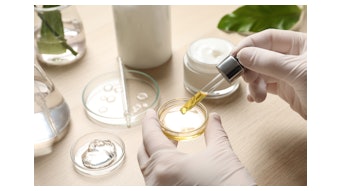
When designing a cosmetic gel or wax, the terms hysteresis and syneresis must be understood, as both affect the physical properties, aesthetics and appearance of a product.
Hysteresis
Hysteresis is a term coined by Sir James Alfred Ewing from an ancient Greek word meaning “deficiency” or “lagging behind.”1 Hysteresis applies to a system’s physical properties, i.e. cloud point, melt point, etc. These properties, specifically in polymeric or impure systems, can be path-dependent, meaning the properties will have different values based on whether the system is heated or cooled. An example of this is the cloud point of a polymeric solution. If the polymer solution is heated from 0°C to 100°C, the cloud point can be a couple of degrees higher than the same polymer solution cooled from 100°C to 0°C.
For example, in a hydrophilic polymer with a cloud point in water at low temperatures, the polymer chains can hydrogen-bond with the surrounding water, making the polymer soluble in water. As the temperature is increased, the polymer chains begin to move around more rapidly, and the hydrogen-bonds start to break down. Once these hydrogen bonds are broken between the water molecules and the polymer chain, the polymer collapses upon itself and a could point is observed.
When the same polymer is used in hot water and slowly cooled, the hydrogen bonds are reformed, and the polymer becomes soluble again. In both the heating and cooling processes, a cloud point is observed, but typically these cloud points will occur at different temperatures due to the difference in making/breaking hydrogen bonds.
Many physical systems naturally exhibit hysteresis. A piece of iron that is brought into a magnetic field retains some magnetization, even after the external magnetic field is removed. Once magnetized, the iron will stay magnetized indefinitely. Demagnetizing the iron would require a magnetic field in the opposite direction. This is the effect that provides the element of memory in a hard disk drive.
Syneresis
Syneresis in chemistry is the extraction or expulsion of a liquid from a gel.2 Typically, when a gel is formed, little pockets of liquid are trapped in a solid matrix. If this matrix packs tightly enough, or the components of the gel are not compatible, the liquid can be forced out of the network. This occurs when dealing with natural waxes or blends of two waxes with different melting points.
Natural waxes are blends of many different components. Typically these waxes have mixtures of hydrocarbons (high molecular weight/high melt point and low molecular weight/low melt point alkyl chains), esters, fatty acids and alcohols. When the wax solidifies, the high melt point components start to arrange themselves into a solid matrix. During this solidification, small molecular weight components (low melt point or liquid) are forced out of the matrix to allow maximum overlap of the high molecular weight components.
For example, during cheese making, syneresis is the formation of the curd due to the sudden removal of the hydrophilic macropeptides, which causes an imbalance in intermolecular forces. Bonds between hydrophobic sites start to develop and are enforced by calcium bonds, which form as the water molecules in the micelles start to leave the structure. This process is usually referred to as the phase of coagulation and syneresis.
Another example of this phenomenon is starch in water. When starch is mixed with water, a free flowing “gel” network is obtained. If a rapid force is applied to this starch solution, water will be forced out of the starch network and the gel will act as a solid. When the force is released, the water returns and the solution flows again. If a pool is filled with the starch solution, a person can walk rapidly across the pool as if they were walking on solid ground. When the person stops walking, they sink into the solution as if they were standing in water. There are videos online showing off this phenomenon.
It is important for a formulator to understand both syneresis and hysteresis when designing a product. When designing a product with a specific melt point or cloud point, it is important for a formulator to know what that melt point is and whether it will change depending on if the system is heated or cooled.
This understanding will help create a product that performs exactly the way the formulator designed it to perform. It is also important, when making blends, for a formulator to know if the components of the blend will separate upon cooling. Even when a small amount of syneresis is present in a blend, the product can feel slimy or have a bad appearance in a cosmetic product. With a good understanding of these two pheonena, it is possible for a formulator to tune not only the physical properties of cosmetic product, but also the product's appearance.
References
1. https://en.wikipedia.org/wiki/Hysteresis
2. https://en.wikipedia.org/wiki/Syneresis_%28chemistry%29