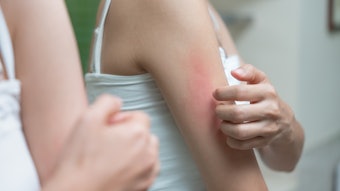
As discussed in a previous article by these authors, contact allergic dermatitis remains a significant public health problem. Its diagnosis and prevention are complicated by the difficulty of identifying allergens responsible for a patient’s condition (i.e., those that have actually caused the allergic contact dermatitis).
The situation with fragrance allergens remains complex because of the relatively limited data on which to define appropriate patch test concentrations, and until recently, the relative difficulty of obtaining documentation that a given consumer product contains the individual fragrance ingredient and its concentration. However, the International Fragrance Association (IFRA)2 recently carried out a number of industry-wide surveys aimed at determining the highest concentrations currently used in fine fragrance products—i.e., the type of consumer products that deliver the highest levels of fragrance in terms of concentration and quantity per unit area. Based on these levels, the current authors propose concentrations that could be used as guides to determine concentrations that could be used for some common patch test systems. These would correspond approximately to the maximum exposure that could be expected from using a consumer product when the dermatologist is confronted with a case of allergic contact dermatitis but has no culprit product to examine.