Color is perceived by the brain when light that has been separated into its individual component wavelengths has been reflected to human eyes by an object or substance. Fluorescence is a different phenomenon, as the emission of light by an object or substance that has absorbed light (usually UV wavelengths) and then emitted light with a longer wavelength.
Materials that fluoresce are referred to as optical brighteners and are used in consumer products. According to Wikipedia, optical brighteners are dyes absorb light in the ultraviolet and violet region (usually 340–370 nm) of the electromagnetic spectrum and re-emit light in the blue region (typically 420–470 nm). These additives often enhance fabrics or paper by producing a whitening effect to make these materials look less yellow though an increase of the amount of blue light reflected.
Similarly, “bluing” used to be added to a load of laundry the make clothes whiter. Unfortunately, optical brighteners are not approved color additives for cosmetics in the United States. However, ingredients that provide visual effects that can alter the performance and visual properties of a product are certainly not prohibited.
The importance of color to the cosmetic chemist is clear, but the importance of fluorescence in cosmetic formulations is somewhat more obscure. Visual perception of cosmetics is equally important, and the search for ingredients to improve the visual appearance of the skin is ongoing. Ingredients, even if they are color additives, can be used for this purpose as long as they are approved for such use.
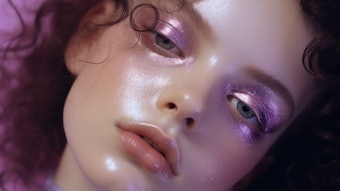
A patent issued in 1998 notes, “The control of specular versus diffuse reflectance in cosmetic formulations is a function of the appearance enhancing characteristics desired for the cosmetic composition. The addition of small quantities of fluorescent compounds added to cosmetic formulations increases the apparent luster, shine or color intensity of the composition. Further, the use of these materials extends to translucent or opaque color cosmetic formulations such as lipsticks, nail enamels and the like where the incorporation of fluorescent brightening compounds into the composition increases the apparent color intensity.”
Another patent in 2001, adds, “It has long been recognized that normal skin exhibits a substantial level of fluorescence (Fellner, Arch Dermatol 112: 667–670, 1976). The fluorescence apparently exists throughout the different layers of the skin, with the epidermis showing the weakest levels, the stratum corneum being slightly stronger, and the most intense emissions being found in the dermis and subcutaneous fat (Zeng, et al., Photochem Photobiol 61: 639–645, 1995). The level of epidermal fluorescence varies depending upon the color of the individual's skin, with darker skins showing a higher level of fluorescence than lighter skins. However, the fluorescence in the dermis is apparently related to elements common to all skin types: elastin and collagen. The spectra of living human skin is measurable over a wide excitation wavelength, with green being the dominant autofluorescence color."
It furthers, "Interestingly, the change in structure of collagen and elastin observed at least with respect to photoaging has been shown to be correlated with a decline in the intensity of fluorescence in the photoaged skin. (Leffell, et al. Arch Dermatol 124: 1514–1518, 1988). This change is also reflected in chronoaged skin, which in middle age begins to lose its green fluorescence, and in later years, loses its blue fluorescence. It is very likely that the decline in the vigorous "glow" common to young, healthy skin is related at least in part to this observed loss of fluorescence. Nonetheless, cosmetics and skin care products have traditionally focused on the camouflaging of the most easily characterized signs of aging, such as wrinkles; there has been little effort to develop products which address the seemingly more intangible problem of renewing the glow of youth in the more mature individual's skin. The present invention now provides a solution to this problem."
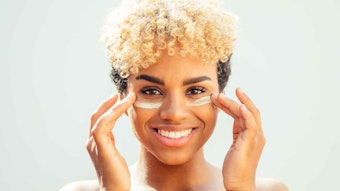
Optical brighteners are also found in cosmetics. According to Wikipedia, "One application is a formula for washing and conditioning gray or blond hair, where the brightener can not only increase the luminance and sparkle of the hair, but can also correct dull, yellowish discoloration without darkening the hair. Some advanced face and eye powders contain optical brightener microspheres that brighten shadowed or dark areas of the skin, such as 'tired eyes'."
While these applications do not actually add optical brighteners as color additives, they add other ingredients that visually perform this task, as in light diffusing makeup.